October is Adopt a Shelter Dog Month.
(Thanks, ASPCA!)
We often advocate for adopting rather than shopping for your new furry best friend. This month, we would like to remind you why it is SO awesome to adopt a shelter dog!
There are thousands of dogs and cats at your local shelter, just waiting to be adopted. They are kind and loving. There are many benefits to adopting these dogs. The fact that they ended up at a shelter does not say anything about them, but speaks volumes about our society.
Dogs and cats are euthanized every day simply because there is not enough room for them at the shelter. When rescuing one pet, you actually save two, since you make space for another to live in a shelter rather than on the streets.

Not one to adopt a dog or a cat? How about a rabbit? These fluffy cuties need love just as much, and are often at shelters, since many parents buy them for their young children without realizing how much work they are. You can also help out your local shelter with product donations, which would be greatly appreciated.
If you or someone you know have been looking for a dog to adopt, now is your chance. During Adopt a Shelter Dog Month, please adopt a worthy mutt. You’ll never know who rescued who. If you’ve adopted a dog or a cat from a shelter, we would love to hear about it!
For this article, I decided to take a different approach. I’m sure there are plenty of awesome holidays this week, but I’m going to focus on a particular job that we talk about a lot, but we’ve never really delved into. I spoke with Andrea Dube, a rehab nurse at a local hospital and a volunteer puppy raiser and mentor with Paws With A Cause.
The Benefits of Training a Service Dog
Handlers of service dogs are given a new lease on life; the dog gives them newfound independence, constant companionship, and often keep their handler from feeling isolated. Service dogs can be life changing, even if you are not the handler. Before training service dogs, Andrea was shy and not all too confident. Once she started training dogs, however, she found it easier to be more outgoing.
“Once you have a cute little puppy at the end of the leash,” Dube says, “fading into a crowd is not possible. The crowd finds you and asks multiple questions. As I learned dog handling skills and to be the leader my confidence grew. Before I know it I was speaking in front of small groups, then larger groups then speaking on a national stage.”

Because Ms. Dube answered all my questions so eloquently, I decided to simply add the interview into the post.
1 Fur 1: What made you want to go into this line of work?
Dube: Well I don’t get paid to this #1. I am a volunteer puppy raiser and Mentor to other puppy raisers. This is what I do when I am not at work. I decided to raise a puppy to pay it forward. My Mom received a Black Lab Named Owen in 2005. She had mobility issues and fatigued easily. She was also very depressed not being able to return to work and live without being dependent on another person. Owen gave her a new life. She could live and travel alone. And if anyone has every lived with a lab, they make you laugh daily. My #1 puppy came home in 2006. His name was Tank. I thought I would stop with one but #11 will be coming home soon. Once you’ve trained a puppy and see them go on to change another life you can’t say no to doing it one more time.
1 Fur 1: How has training service dogs changed your life?
Dube: The friends I have met along this journey is a added bonus. Young & old, other puppy raisers, clients, Paralympic athletes and PAWS staff have all become my family. Friends from many states that I would have never met if it wasn’t for puppy raising.
1 Fur 1: What advice would you give to people who want to train service dogs?
Dube: First thing I would say is that you will never be sorry you did it. Even once. Yes you have to be strict & consistent with training. they cannot be spoiled. It’s hard at first. You don’t think you know what you are doing, you don’t think you could ever give them up (yeah that’s a tough part) new puppies are newborn babies- they don’t sleep, they cry, they pee on the rug a million times. But with time and training and a little love they flower into a strong confident dog. You can say “I did that” They make you so proud with each time they “get it”. You are so excited as they go off to doggy college. what will they do? where will they live? How will they help someone? It is a great family project and teaches kids to do something for another person. You are giving your heart away so someone else can live. That’s a great lesson. we have several families that have asked the kids if its too tough, their response is always No Mom we want to do it again.
1 Fur 1: How have your separate experiences, with training, working in a hospital, using service dogs differed? How are they alike?
Dube: I am a rehab nurse. This means I teach people how to walk and talk and dress themselves again after some life changing event. I takes lots of repetition to get positive results. I have to be the cheerleader. Some days potty training adults and puppies can be very similar. I’m teaching people tools to use to make each task easier. A service dog can be one of those tools. Most of both jobs is Education. Education of the patient and the families & education of the public. I’m teaching what a service dog can do and what is appropriate behavior for the puppy and the people who try to interfere with our training. “Oh it says do not pet? I know that sweet puppy won’t mind a bit!” I am teaching the clients what their rights are under the ADA and to try to educate the public when their rights are being violated. As I’m training I get very rude comments like “you don’t look blind” or “we don’t allow pets in here”. When I can clarify the rules with the uneducated it’s that much easier for the disabled person who comes behind me to be treated with the respect they deserve. Many disabilities are invisible. It’s against the law to ask what is wrong with you, and it’s plain rude.
1 Fur 1: What does Paws With A Cause bring to the table?
Dube: I love all service dog organizations, but PAWS is very special to me for many reasons. They custom train each dog for each client. No dog is exactly the same, as no person is. They match the dog’s personality to the clients. They also do all the custom training in the client’s community. It’s tough with someone with a disability has to travel and go to “boot camp” to learn how to use the dog. They also provide lifetime training of the dog. If you 1st needed a cane but now need to use a wheelchair, PAWS is there to add to the dogs training. They monitor the condition & the training of the dogs every 2 years to make sure they haven’t lost any skills and are being treated well and are at a good weight to work.
Getting Involved

PAWS With A Cause is a non-profit – all the dogs they train are at no cost to their new owner. Training dogs can get to be quite expensive, but PAWS relies on the generosity of donors to make their work happen. PAWS also keeps their dogs from losing their training by checking up on each dog every two years, ensuring that they haven’t forgotten what they learned.
Thanks again, Andrea, for your experience and expertise!
I know we often focus on dogs, cats, and the occasional goat when talking about animal assisted therapy and activities. For World Animal Day, however, we’re going to switch gears a little bit. We’ve briefly touched on the fact that wildlife helps with animal assisted therapy with the assistance of licensed therapists, but today we’re going to zero in on two unique cases.
Elephants
People are often taken aback when they find out elephants help facilitate therapy. It only makes sense – elephants are gentle and intelligent creatures. When children with disabilities come into contact with them, they cannot help but be awed and inspired by these amazing creatures. The first case of animal assisted therapy using elephants helped a blind young girl become more confident and change her life for the better.

There are only three elephant types that exist in the world largely due to the ivory trade and habitat loss. Once common throughout Africa and Asia, elephant numbers fell dramatically in the 19th and 20th centuries and now the global population is down to only 200,000. In the U.S.A. elephants are suffering in other ways; sold on the black market and being forced to perform in circuses and other animal shows. One organization has made it their mission to rescue these gentle giants and provide them with medical care and space they need to live a healthy life. Please click here to learn about PAWS (Performing Animal Welfare Society) based in California.
Dolphins
Dolphin assisted therapy has been used since the ’70s. Originally to help children with cognitive disorders, dolphin assisted therapy has been proven to help all kinds of conditions, including mood disorders and addictions. Dolphins are very similar to people. They are playful and are very emotionally intelligent.

Dolphins are being hunted, slaughtered or captured. The captive industry has become a billion-dollar worldwide trade, with all money made from the exploitation, imprisonment and lifelong suffering of these sentient beings. Rescue organizations, like Sea Shepherd Conservation Society, launched its Operation Infinite Patience campaign. Their presence of volunteers from around the world who remain on the ground in Taiji, Japan documenting the cove throughout the entire dolphin hunt season. Click here to learn more about this initiative and see video of this reality.
These wildlife animals are two of the kindest, most intelligent animals on the planet. They are also in grave danger. Both are being poached almost to extinction. Elephants are hunted for their tusks, while dolphins are hunted for their meat. Not only would both of their ecosystems drastically change, but we would also lose two amazing creatures.
This World Animal Day and everyday, 1FUR1 urges you to take action! Please let us know of deserving US non-profits that help animal or donate to help save animal assisted programs.
Why you should consider adopting a deaf pet?
If I told you all of the reasons deaf pets are amazing, we would be here all day. Instead, I’ve shortened the benefits list of adopting a deaf pets down to a few key bullet points:
- You can practice your sign language skills!
- There are many adorable deaf pets just waiting to be adopted
- You can bring them to concerts and it won’t hurt their ears
- Just look at these adorable faces!
- They wouldn’t be afraid of fireworks
- These sweet pups are just as intelligent as hearing dogs
- Their love for you knows no bounds
For the third and final time, happy Deaf Pet Awareness Week! Throughout this week, we saw an adorable bond form between a dog and her new family, we were reminded that DO.FRO.YO is an awesome treat for dogs, and we learned multiple tactics to train deaf animals. Finally, we answered the big question – if you have any you would like to add, feel free to contact 1 FUR 1 Foundation on Facebook or Twitter and let us know about your fantastic deaf pet!
Once again, happy Deaf Pet Awareness Week. Many people avoid adopting deaf pets because they think that it would be impossible to communicate with them. Unbelievable! It only takes patience and a little bit of determination to train your deaf pet.
Sign Language
One of the most important things will be figuring out a hand signal that means ‘yes’ or ‘good’. You will be using this a lot, since I’m sure your pet is a “good boy!” or “good girl!” Make up hand signals for all other commands you use, or use some words from the American Sigh Language. Be consistent with the way you, your family, and anyone else training the animal signs.
If you want more information on sign language training, there are plenty of resources out there made just for you. If your pet is going deaf, make sure to start associating hand motions with voice commands so they can get a hang of it quickly. And, of course, your pet needs plenty of treats while they’re being trained, so make sure to buy them the good stuff.

Alternative Solutions
Technology is amazing. Vibrating collars are now available for your hard of hearing pup. These collars allow you to train your pup with ease. However, these collars have to be tight in order for the dog to feel the vibrations, which can be traumatizing for some.
There is another solution that requires no additional training – using a lead. Most owners typically do that, but owners of deaf pets need to remember not to let their dog off leash. I suggest investing in a longer leash so that your pup can explore without being restricted.
Things to Remember
The biggest thing to remember is that your pet cannot hear you. It’s pretty silly, since you know that and are not likely to forget it, but don’t get frustrated when your pet ignores you. You also need to make sure you approach your pet from where they can see you. If you don’t, they might get afraid and rebel. And I know none of us wants that to happen.
Is your dog slowly losing their hearing? Don’t worry – they adjust pretty well. For many dogs, it’s just a part of life. And for some dogs, like my nine year old Golden Retriever, they simply don’t listen to you as they grow older. So, either way, realize that your dog is going to be less responsive and, most likely, sassier as they age.
Any dog can be born deaf or become deaf (although it is most likely, statistically, for Dalmatians to be born deaf). These dogs are just as silly, caring, and deserving as love as all others. The only difference is that they aren’t afraid of the vacuum cleaner.
Happy Deaf Pet Awareness Week!
Throughout this week, we’ll post various short articles that show how deaf pets are just as amazing and loving as all other animals. To start the week off right, here is a great video that will tug at your heartstrings.
Rosie’s Story
I’m not going to lie, I definitely started crying while I was watching this video. This wonderful family adopted such a loving, deserving dog. Deaf dogs, and dogs with any sort of special needs are in no way “damaged goods.” They are fantastic creatures who need patience, kindness, and love, just like the rest of us. The only hurdle to jump with a deaf dog is deaf education – but American Sign Language and unorthodox training techniques are great for everyone to know. None of us is perfect; why would we expect our pets to be?
Be sure to look out for our other posts for Deaf Pet Awareness Week!
Every dog is special. They all bring something to the table. Even when the odds are against them, they continue to be happy pups with lots of moxie. For Pet Birth Defect Day, I’m going to highlight three examples of amazing dogs who don’t let anything, especially not some pesky little birth defects, stop them.
Stitch

Stitch, a two year old Pit Bull, is not the stereotypical version of beauty, which made his getting adopted a bit difficult. He was given a new lease on life when he was adopted by a young mother of two. He and the two children shared the same condition: all three had cleft lips and palates. “I just wanted to show my kids that they are not alone,” Rodman told KRNV-DT Reno. “It’s not only other humans that have this, cleft lip and palate, but animals have it also.” Stitch was not trained differently from other dogs; he just showed everyone that pets with birth defects are like the rest of us. Everyone deserves love and happiness.
Smiley
Smiley is not only a cute puppy name, but also a perfect description of this next dog. Born without eyes, this sweet Golden had a ruff time growing up (pun intended). He was rescued from a puppy mill when he was between one and two. Like most puppy mill survivors, he was very anxious around new things. After tons of patience and training from his handler, and the start of an adorable friendship with a deaf Great Dane, he became the paradigm of well-behaved dogs. He is now a registered therapy animal and lights up the lives of those he meets.
Lt. Dan
I know you’ve probably had your fill of cuteness, but bear with me because we’re almost done. Last but certainly not least on the list is Lt. Dan. Here we have your typical relationship between a young girl and her pup: they’re basically joined at the hip, with the puppy happily trotting along behind his master. The two share many similarities. They are both playful and share a curiosity about the world around them. Sapphyre had both of her feet cut off due to a birth defect. When she last went to the hospital, she not only returned with a pair of snazzy new prosthetics, but also with a puppy. Lt. Dan shares her condition, but of course, never lets that stop him.
Birth defects don’t make anyone less than. They make each person unique. As Sapphyre’s mother said, “..being different is not bad. People, even pets, no one is exactly the same. That would be boring.”
The motto of the Boy Scouts is famously “Be Prepared,” and as a pet owner there is a lot you can do to be prepared for disaster as well. For National national Preparedness Month we take a look back on how these 1FUR1 blog articles preparing you and your pet for the worst:
Pet First Aid Tips
When you pet is choking, having a seizure, consuming something poisonous, or otherwise in a dangerous situation, it can be terrifying, but there are steps you can take to ensure its safety. This article shows you how the American Red Cross, Pet Tech, and local animal hospitals offer courses on pet first aid to teach you what to do in an emergency. (However, you must take it to a vet in an emergency as well.)
Preparing for Natural Disasters With Your Pet
You may know to stand in a doorway for an earthquake or find a ground-level windowless room for a tornado or hurricane, but your pet doesn’t. This article prepares both you and your pet for a natural disaster, from making an emergency kit to what exactly to do if disaster strikes, plus how to help your pet cope with life post-disaster.
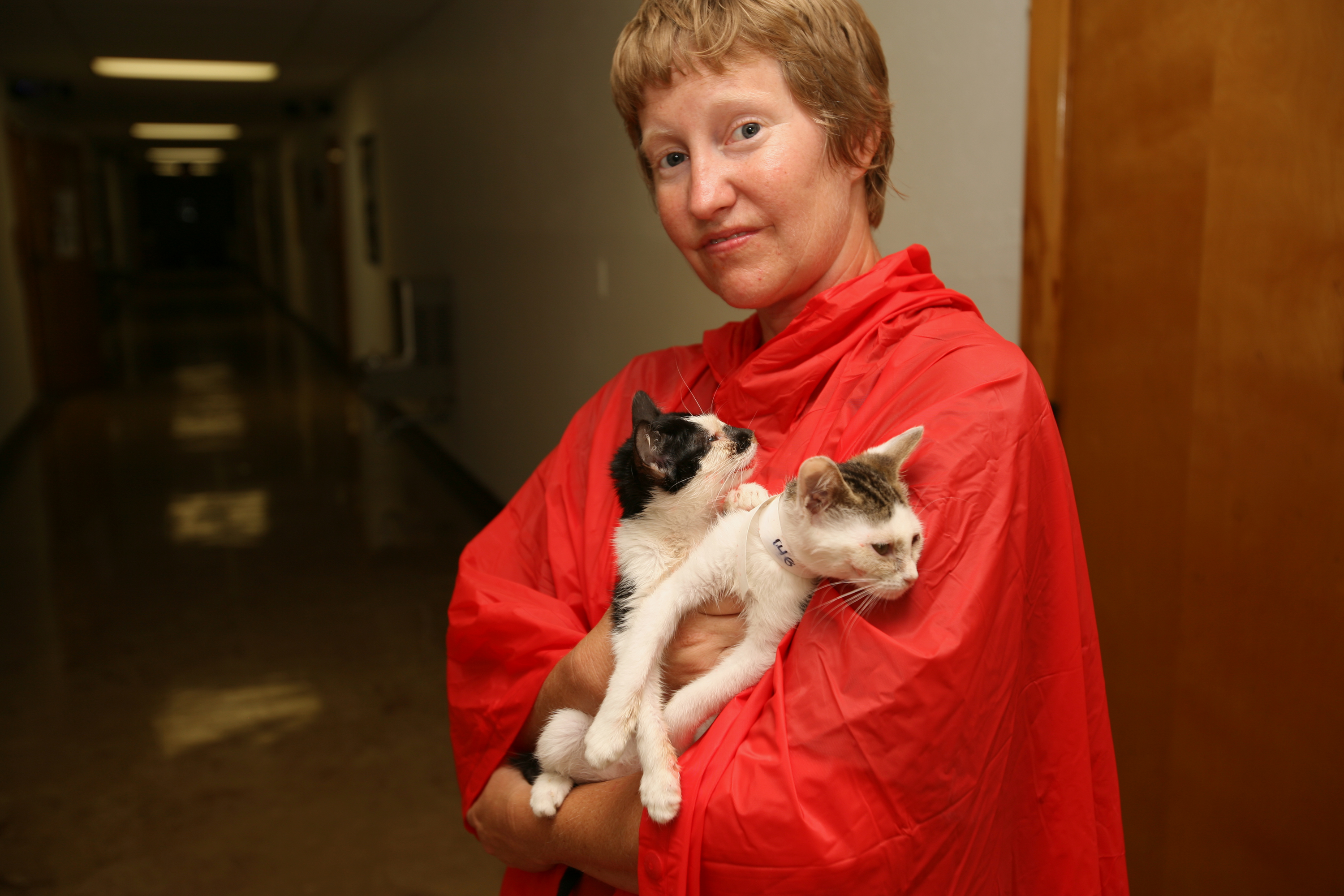
Coffeyville, KS, July 17, 2007 – Kim Veitch, a Humane Society volunteer holds two cats rescued in recent flood and oil spill. FEMA partners with volunteer organizations to assist in disasters.
Pet Fire Safety Tips
Unlike unpredictable natural disasters, fires caused by pets can be prevented, and this is imperative as 1,000 fires are started by cats and dogs each year. This article shows you how to both prevent a fire when pets are around, such as by keeping puppies away from electric cords, to tips on how to let first-respondents know that you have a pet.
Lost Pet Prevention Tips
The stress of a natural disaster or fire, or even a happy occasion like the Fourth of July, can make some pets run away, and sadly only 20% of lost dogs and 2% of lost cats are returned to their owners annually. Prevent this tragedy by reading up on microchips, collars, and what types of dogs are most likely to be stolen.
Keep checking back to our blog at 1FUR1 to learn how to keep your pet healthy, happy, and safe! We hope you never have to apply the information learned here, but we want you to be prepared if a disaster strikes.
Happy Labor Day! This holiday is used to celebrate people throughout the United States who have hardworking jobs, but where is the labor day for working dogs? They work just as hard, for long hours without pay (besides love and treats). Let’s take this opportunity to recognize their amazing work.
Military and Police Dogs
War dogs have been around for centuries. They have been used by Attila the Hun, Napoleon Bonaparte, and William the Conqueror, among many others. Dogs are used in times of war because of their loyalty and strength. Though dogs have been worldwide for a long time, America does not have quite that extensive history. Native Americans used dogs to keep watch, but Americans descended from the British did not start using dogs until the end of WWI. Even then, the dogs were trained by the French and English. Since the first military dogs were trained and used in battles, they have gone on to do amazing things.
Greeks, Persians, Babylonians, and Assyrians were the first to use dogs as police dogs. They were also used in the search for the infamous Jack the Ripper in the 1800s. Though they were unsuccessful in that endeavor, they are great assets. The American police force used dogs in the 1970s. Since then, the dogs have helped to keep billions of dollars worth of drugs off the streets and prevent suspects from running because, honestly, who would try to run from a snarling German Shepherd?

Therapy and Assistance Dogs
Therapy and assistance dogs do great things to help civilians. (It’s alright if you don’t know the difference between the two. You can find that out in this previous article.) We have been working with therapy dogs, who do great things, such as visit people in hospitals, for quite a while now. With your help, 1FUR1 hopes to get our first ever service dog program off the ground. Service dogs transform lives, giving people with disabilities newfound freedom and independence.
All working dogs have been valuable additions to the lives of their handlers, and most likely the lives of many others. So, if you know any working dogs, be sure to give them extra pets and treats this Labor Day.
Natural Holistic Pet Day is Aug., 30th so to celebrate, we’re all going to learn about some holistic pet remedies for those poor furry babies suffering from anxiety.
Many pets have anxiety, but it often goes unnoticed. To make sure you know what’s going on in your pet’s mind, make sure to check if they show symptoms of anxiety. Symptoms include incessant barking or whining, panting,  fear-based aggression, and repetitive actions such as chasing their tail or licking the same area over and over again.
Some animals become anxious because of stimuli in their environment, while others simply have anxious personalities. Anxiety can take different forms: some animals are generally anxious, others are only anxious when their owners leave, while still others only have a few things that trigger them. Whatever the reason for the anxiety, I have compiled a list of natural remedies for your pets. Medicines are always an option, but consult your vet before you turn to that solution. Feel free to use any of these solutions and let us here at 1FUR1 know what works best for you!
1. Treats
Treats are a fan favorite among dogs and cats. They can be used as both rewards and anxiety remedies at the same time. These are a great all-natural way to calm your pet without changing her routine at all. There are many different options for calming treats, so make sure to go into your favorite pet shop or research to find which is best for your pet.
2. Oils
Oils are a great way to calm your pet. You can rub oils such as lavender, chamomile, lemon balm, and Valerian on their paws, ears, or in their fur. Essential oils have been found to be extremely effective when treating anxiety. They also give the area your pet has been a great, relaxing smell. Aromatherapy can be helpful for dogs who don’t want to have lemon balm rubbed all over them.
3. Chew Toys
Another favorite of many pets, chew toys provide a familiar vehicle to help calm anxiety. Normal toys provide a distraction from the stimuli making them anxious. Many pet shops sell chew toys specifically for anxious dogs, which help to calm them and entertain them for hours.
4. Music
In my experience working with dogs, classical music helped to calm all the dogs down. At the Doggie Day Camp, the rowdy bunch turned into a group of relaxed sweethearts on the verge of falling asleep. However, classical music doesn’t work for everyone. Before you ask, of course there is music made specifically for pet anxiety. This music is specifically designed to be simple, so as not to overload your pup or kitten with too many sounds at once.
5. Clothing
I know we all love dressing up our pets, even though they tend to dislike it. These two natural solutions let us dress them up in a way that is more enjoyable for them. The Thundershirt is a great way to calm down your pet without constricting them. I may be biased, because my nearly two-year-old Goldendoodle has one that has helped her immensely. Within minutes of her Thundershirt being put on, her breathing is slowed and she is relaxed as can be.
If you would prefer not to put a shirt on your pet, there are calming collars to consider. These are great because it is an article of clothing your pet is already used to wearing and they have great smells such as lavender chamomile. They are also available in adorable bow tie designs to keep your pet looking dapper during stressful situations.