We have discussed before the benefits of therapy animals for Alzheimer’s and dementia patients, but in honor of Senior Citizen’s Day 2015, let’s delve deeper into the human-animal bond of senior citizens and therapy animals. Senior citizens suffer high rates of depression due to loneliness, from the passing of a spouse, lack of visits from family and friends, or no longer being mobile enough to enjoy the independence they once had. Animal-assisted therapy (AAT) animals ease this loneliness, but not in the way one would expect. While AAT animals relax patients and make them happy, Dr. Savishinsky published in the Central Issues in Anthropology journal that, in his experience, senior citizen patients may actually use therapy animals to connect better to people as well as animals.
AAT facilitators know this and encourage senior citizens to interact with animals but also with other people. The animals serve as a “jumping off point” for human conversation and, while asking questions about, for instance, a therapy dog’s fur, the patient feels comfortable opening up about how the dog reminds him of when he was a young boy growing up on a farm filled with dogs.
The benefits of AAT animals and having pets in assisted living facilities are well-documented, both in scholarly journals and anecdotally.

This picture of an elderly gentleman holding a “just adopted” kitten went viral on the Reddit “Aww” board a couple of years ago, prompting hundreds of users to share stories of how they adopted pets for their elderly parents or grandparents for companionship and the profound effects the experience had on them. Many critics say having pets in assisted living facilities would make things unsanitary or otherwise unsafe, and while there are strict cleanliness and insurance guidelines to allow pets into these facilities, facilitators praise having animals. For instance, The Clare Senior Independent Living Community, in partnership with 1FUR1 grantee Tree House Humane Society, has been introducing animal assisted activity cat visits, Nikki Gamble the Life Enrichment Manager had this to say about our program:
- “For our residents who are cat lovers, nothing will bring greater pleasure to them than to hold a soft, warm, purring cat in their lap.”
- “Having cats as therapy visitors is unique and it brings joy to the residents who meet them.”
Pets benefit people of all ages, but senior citizens find that they have fewer heart problems, instances of depression, and higher instances of sociability when they have pets. Look back at the picture of the old man holding the black kitten – that is the smile of a man who has a friend for life.
Black cats are unfairly maligned, given their reputation as being bad luck. However, for Black Cat Appreciation Day, we’re listing the top seven black cats in pop culture who are working to break the stereotype with sass, song, and relentless pursuit of a certain Tweety Bird.
7.) Scat Cat, “The Aristocats”
In this charming Disney film from the 1960’s, Scat Cat is Thomas O’Malley’s trumpet-playing, streetwise alley cat friend. It is he who sings the song “Everybody Wants to Be a Cat,” a jazzy tune that’s as catchy as Disney’s recent hit song “Let It Go.”
6.) Kitty Softpaws, “Puss in Boots”
Who could give fan-favorite “Shrek” character Puss in Boots a run for his money–sometimes literally? That would be Kitty Softpaws, a ruthless thief voiced by Salma Hayek. She matches Puss in Boots in wit, cunning, and salsa moves.
5.) Felix the Cat
Felix the Cat starred in silent cartoon shorts in the 1920’s with the likes of Charlie Chaplin and Cecile B. DeMille. These shorts are considered to be the pinnacle of animation by everyone from Aldous Huxley, author of “Brave New World,” to critics today.
4.) Luna, “Sailor Moon”
Luna is the guardian of Usagi, the eponymous “Sailor Moon” character. Luna is very wise and gives good advice, but as Usagi is a 14-year-old girl, her advice is mostly telling her to do her homework and to not be late for school!
3.) Thackery Binks, “Hocus Pocus”
Thackery was once a teenage boy, but he was cursed to be an undead cat by three witches. Three hundred years after their deaths, the witches rise from the dead and Thackery uses his knowledge of the witches to help main character Max get rid of them.
2.) Salem, “Sabrina the Teenage Witch”
Like Thackery Binks, Salem was also cursed to live as a cat for a hundred years. He bides his time by living with Sabrina and her aunts, sometimes giving advice but mostly giving sass and sarcasm, getting caught up in harebrained schemes to get rich or take over the world.
1.) Sylvester, “Looney Tunes”
We tawt we taw a puddy tat at number one! Sylvester is famous for his wacky attempts to get at Tweety Bird and for saying “Suffering succotash!” when his attempts inevitably fail. This “wile e” cat sometimes teams up with his little canary enemy, though. For instance, to play basketball with space aliens in the 1990s.
Honorable Mention: Black Cat, the Marvel universe – While not technically a black cat, the Marvel universe has a villainess named Black Cat. The alter ego of Felicia Hardy, Black Cat is known for being New York’s premiere cat burglar and Spider-Man’s ex-girlfriend. And, unlike the harmless black cats on this list, at one point in the comics, Black Cat was actually cursed to cause people bad luck!
Happy International Homeless Animals Day! While it’s somewhat depressing that we need this holiday, people around the world are doing amazing things to help homeless animals. Let’s take a trip around the world to see some examples of people celebrating our relationship with animals via festivals or ingenuity.
In Nepal

Picture: One of the dogs at the Tihar Festival being pampered with garlands.
The second day of the Tihar Festival celebrates our friendship with animals. The five day festival The dogs are adorned with garland and colored dyes. And, of course, given plenty of treats. There is even a special ceremony for police dogs.
In Russia
Homeless dogs are everywhere in Sochi. You may remember post-Olympics, American athletes wanted to bring some of these pups home. They were successful, and since then ten dogs have been brought to the US. Though this is not a festival, it goes back to the real goal of this article – to teach people about International Homeless Animal Day and how to help homeless animals in their community. Also, it lets us think about big, strong athletes, such as Gus Kenworthy, carrying around adorable little puppies, which is always a nice image.
In Thailand

Picture: An annual event held in Jaipur, the capital city of Rjasthan honors elephants and the significant place they hold in Indian society.
The Surin Elephant Round-Up celebrates our unique relationship with elephants. Held on the third Saturday of November, this event involves more than two hundred elephants who entertain people with various tricks, including folk dancing. Beginning in 1960, this festival has religious history as well as the obvious cultural significance. Elephants are revered in Buddhism, so this event is celebrating the history of elephant hunts, where rituals were performed. Though this festival has become more modern, with elephant soccer games and tourists more than welcome, the roots of the relationship between the people of Surin and these gentle giants.
In Denmark
There is another competitive festival – but this one involves bunnies, rather than worms. As a former owner of two dwarf rabbits, I could be biased, but I’d say this event is cuter than the one taking place in NC. The fluff-balls compete in rabbit hopping competitions, which would be purely instinctual, if it not for the leashes they wear while competing and the trainers they have to ensure they win. Rabbit hopping is very prestigious, as it takes two to three years to get a rabbit ready to compete in the big leagues. Though this is quite a commitment, the results are utterly adorable and surprisingly graceful.
In Scotland

Picture: This event, started by the Golden Retriever Club of Scotland, seems to be the perfect way to spend a summer afternoon.
An annual Golden Retriever festival is held annually by the Golden Retriever Club of Scotland. This event is as amazing as it sounds – a huge collective of golden retrievers running around in a field. This event, called the Guischan Gathering, has taken place every July for the last nine years. Might just be me, but I think this festival is a snapshot of what heaven looks like.
In North Carolina
A different version of Groundhog Day is celebrated. Instead of adorable, sleepy groundhogs, competitive worms are involved. Yes, you read that right. At the Banner Elk Woolly Worm Festival, worms race. The winning caterpillar then analyzed by forecasters, who use their findings to determine what future weather will be like. Of course, winners aren’t born – they’re created. Each caterpillar has a coach; the victorious coach receives $1000 and the most unusual bragging rights.
Traveling back to Thailand

Picture: www.theworldfestival.net offers us a sneak peak at the food pyramid at the Monkey Festival.
Thailand seems to be a wonderful place for animal festivals. This festival combines animal appreciation with another fan favorite: all-you-can-eat buffets. Let me introduce you to the Monkey Feast Festival. Held at the Angkor Wat Khmer ruins, this festival provides sweets, soft drinks, vegetables, and fruits (especially bananas, of course) for the myriad of human and thousand of monkey guests. The Khmer dynasty built many Hindu temples, including Angkor Wat. Since the monkeys took over these ruins, it’s only fitting that this festival is held there to honor the marquee monkeys. Held at the end of November, this is a great alternative to a traditional Thanksgiving feast.
In Chile
The annual Birds of Chile Festival is each October. This four day festival includes bird watching excursions and talks by bird experts. You also get the chance to see amazing ecosystems and the beautiful coast of Chile. Meet your fellow bird lovers and see some of the beautiful Chilean birds. Be sure to print out a list of the many birds to see how many you can spot!
In Turkey
Some kind geniuses invented a machine that dispenses food for stray animals every time a bottle is recycled in it. It’s a super cool way to help the environment and pups and kitties in need. If you’re ever in Turkey, be sure to bring as many recyclables as possible for these machines. Though this is not a festival, it deserves to be included on this list because of its extraordinary feat of helping these homeless animals.
How can you help?
- Sign petitions that inspire social change.
- Go to an adoption festival and events.
- Volunteer or foster for your local animal shelter.
- Donate to non-profits that work to help animals that are homeless or in need.
- Know of a puppy mill? Report them. They exist solely for profit and treat the animals terribly.
- Can’t think of anything else to do? Have no fear, Oprah is here.
Visited one of these festivals or think others should have made it on this list? Let 1 FUR1 Foundation know via Facebook or Insta @1fu1impact!
When you think of working “like a dog,” you’re probably picturing yourself burning the midnight oil behind a computer, finishing one last project for your boss. But what about working dogs? On National Work Like a Dog Day, we would like to spotlight three of the many ways dogs work to put people at ease.
Service Dogs
It is a common misconception that “service dog” is a catch-all term for dogs who help people with disabilities, including visually impaired or hard of hearing individuals. In actuality, guide dogs help the visually impaired and hearing dogs help the hard of hearing. (More about them in a moment.) Service dogs can help those with physical disabilities, autism, seizures, diabetes, mental illnesses, and a multitude of other illnesses. Depending on the needs of the patient, service dogs can be trained to do physical tasks such as flipping light switches on or off or opening and closing doors, or emotion-related tasks such as whining or barking when the patient starts to have a panic attack or bipolar manic episode.
Guide and Hearing Dogs
Guide and hearing dogs are very similar in that they are trained to take account of their surroundings as well as their handler’s commands, and they have to make the judgment call to stay safe at all costs even if their handler is commanding otherwise. Hearing dogs nudge their owners when alarms go off–“alarms” here meaning fire and other hazard alarms but also oven timers, the doorbell, or a phone ringing–and lead them to the source of the noise, while guide dogs are directed where to go by their handlers, stopping at crosswalks and steps/curbs. While service and hearing dogs can be almost any breed and can be adopted from shelters, guide dogs are almost always Labrador and Golden Retrievers and German Shepherd dogs, bred for the job and rigorously trained before being placed with their handler.
Therapy Dogs
Therapy dogs can be any breed and have to be highly trained, but not necessarily trained-from-puppy-age like guide/hearing and service dogs. What separates them from service and guide/hearing dogs is public access. You can find therapy dogs in schools, hospitals, courtrooms, libraries, and other places, granted they have the express permission of the facilitators, but you will not find them in public with their handlers in the grocery store, for instance, or a restaurant, or other privately-owned places where the owners have said “no pets allowed (save for service animals).” Though it’s an emerging trend for owners to train their pet dogs to be therapy dogs, therapy dogs should be considered to be working dogs, as the jobs are physically and emotionally taxing for both dog and owner.
Some common working dog etiquette: if you see a working dog with its handler, do not pet it. A therapy dog will approach you or its handler will encourage you to come pet it, but service and guide/hearing dogs need to focus. Some handlers will let you pet their dog if you ask their permission, but never reach out and pet a working dog, or offer it treats, toys, or other distractions. If you are a business owner, assume all service or hearing/guide dogs are ‘at work’ and do not ask for identification or confirmation that the dog is a service dog (this is not only proper etiquette, but the law). This helps service dogs help their handlers!
Many people see the phrases “assistance dogs”, ‘therapy dogs” and “service dogs” as interchangeable. Yes, they are examples of dogs doing amazing things to help humans, but that is where the similarities end. For this week, International Assistance Dog Week, we’re going to talk about the differences between all these categories.
Therapy Dogs
Therapy dogs are often the most publicized. These are the dogs visiting sick children in hospitals and elderly people in assisted living homes. They are the focus of many uplifting YouTube videos. Their training is very different from that of service dogs. Therapy animals provide psychological benefits to people other than their handlers. Sure, having a therapy dog is awesome, but the pup’s main focus is helping those they visit.
Therapy dogs go through extensive training, but not every dog can be a therapy animal. It really depends on the temperament of the dog. The dog should be friendly, well-socialized and, most importantly, love being around people. My parents used to have two dogs: an elderly golden retriever and a goldendoodle puppy. They adopted the doodle with the hopes of having her be a therapy dog. However, she was very skittish and took a while to warm up to people. The golden, on the other hand, loved all people and was happiest when she was getting pet. This distinction is important because, although the puppy would probably have been able to be certified as a therapy dog, she would not have enjoyed the experience.
Assistance Dogs
Therapy dogs are often mistaken for assistance dogs. Assistance dogs tend to work one-on-one with someone who is, well, in need of assistance. There are plenty different types of assistance dogs, who have intense training for their specific tasks. Some dogs are seizure dogs, who help warn their owners of impending seizures and respond to seizures. There are also dogs trained to help those with PTSD to cope when having flashbacks.

Co-founder of Paws and Stripes trains a shelter dog to help soldiers with PTSD.
There are also some more well known types of assistance dogs.
- Guide Dogs
- Guide dogs occasionally lead sightseeing tours around cities. They spend most of their time work with people with visual impairments, leading them where they need to go and helping them avoid unsafe surroundings.
- Hearing Dogs
- Hearing dogs work with the deaf, making their owners conscious of everyday sounds and provide increased awareness of their surroundings. It takes four to six months of hard training (with toys and affection) for these dogs to be ready to work.
Emotional Support Dogs
I know this is a rather long article, but bear with me. This is the last stop. Emotional support dogs, a category of emotional support animals, are a rather new group. These dogs don’t have to be trained, but do an important job. They provide people with emotional problems support and comfort. This bond reduces the effects disabling psychiatric ailments, providing a positive immune boost or decreasing healing time.They aren’t allowed in quite as many places as assistance dogs, but can live essentially anywhere. They are protected by federal laws regarding housing.
Each one of these dogs does amazing work. Please consider donating to 1FUR1 service dog program and be part of the efforts helping U.S. veterans suffering from PTSD adjust to civilian life. Donate and be the one to make a difference!
Happy August 1st! Did you know that today has been coined DOGust 1st by the North Shore Animal League America? This means that today is the universal birthday for shelter dogs whose birthdays are unknown. It is easy to tell a dog’s birth year, but almost impossible to tell their birth date. Many shelter dog owners choose the adoption date or a close friend’s birthday to be their pup’s birthday. Others choose holidays that suit their pet’s personality – Chino’s owner chose Valentine’s Day as the little love-bug’s birthday.
Alright, so now that you have a day to celebrate fido’s birthday, what do you do next? Throw them a dog birthday party, of course!
Planning the Party
- Pick a date. Find a day, most likely a weekend, that works for you, your friends, and your dog’s playmates.
- Plan the menu. Make sure to include both dog- and people-friendly food. Separate the two of them, keeping the human food out of paw’s reach.
- Since it’s a party for your dog, after all, look up a recipe for a doggie birthday cake.
- Find a location. If you have a yard or a pool, that would be a perfect place to hold the party (as long as you have a lifeguard watching the dogs at all times!). Other places that would work well include parks and dog parks. You can also have an indoor party, as long as all the dogs are potty trained and the space has been puppy proofed.
- Decide who you are going to invite. Be sure to invite your fellow animal lovers and your pup’s playmates. Make sure that none of the dogs invited are aggressive. This is important to remember so that your party goes smoothly, with everyone having fun and no one getting injured.

Pool parties are great for hot summer afternoons.
Party Activities
- Throw a pool party! Plenty of dogs love swimming, and for those that don’t, relaxing poolside is always a great way to spend an afternoon.
- Have an ice cream social! This is a perfect idea for hot summer days. Delicious ice cream and DO.FRO.YO will keep the pups from becoming hot dogs.
- Celebrate with a beach day. Most dogs love the beach. There are fun options for everyone; pups can jump waves, dig in the sand, relax while getting a tan, or roll around in stinky seaweed.
- Leave tons of toys around for the dogs to play with. With this idea, you and your fellow humans can sit back and relax while the dogs tire each other out. They can play Frisbee, tug of war, dig, or chew on toys. Be careful about leaving out bones, because many dogs tend to be toy aggressive.
- Help pets less fortunate than yours! Set up a place for your friends to leave unused toys or gently used blankets to donate to your local animal shelter. You can also pick a worthy cause to collect money for. This is a great way to make a difference in the lives of animals in your community.

Party hats are a great way for humans and dogs alike to celebrate.
After all, DOGust 1st is the perfect day to donate – dogs in shelters deserve birthday presents too!
Any dog owner will tell you that they have the best dog in the world. Dogs from breeders are sought after, snatched up and pampered the rest of their lives. But what about the mutts who don’t have the same privileges?
I spoke with Liz Kover, Animal-Assisted Activities Director at Marley’s Mutts Dog Rescue, about her experiences working with mutts. Marley’s Mutts is an all breed 501(c)3 non-profit based in Kern County, CA. that works to save shelter dogs who are about to be euthanized. They work with these orphaned animals to rehabilitate them and get them adopted into loving homes. Many of the dogs are involved in Marley’s ‘Miracle Mutts’ community outreach programs which takes place in libraries and school assemblies where participants take life skills and/or reading classes. Click to learn more about Barks and Books.
“It’s important people understand that mutts aren’t damaged goods. They’re incredible dogs that deserve love. All of them have stories. Most come from awful backgrounds, which makes them special because they’ve overcome this without resentment towards people,” shared Kover, “We can relate to these dogs, especially because they have had hardships in their lives and they have triumphed. We can look at dogs to learn that we can move forward. It’s [truly] inspiring.”
Perks of Adopting A Mutt
- They are generally less susceptible to genetic health problems. Mutts have lower rates of hip dyspepsia, certain knee diseases, most spinal diseases, many heart diseases, plenty of cancers and a whole lot of skin, blood, brain, liver and kidney diseases, among others.

- They tend to be less expensive. Purebreds, or hybrids in high demand, can go for several thousands of dollars. The typical mutt usually costs a few hundred bucks, if that.
- They are in desperate needs of homes. Many shelters are overcrowded and cannot accept dogs who need their help. By adopting a mutt, you are saving two lives: the live of your new partner in crime, and the life of the needy pup who the shelter can now accept.
- They are unique! No two mutts look the same, since many are crazy mixtures, which no breeder would think of putting together.
- Finding out their breed can be a fun guessing game! Oftentimes, dogs are identified as the one breed which they most look like. However, mutts can be any number of different breeds. Other people try to figure out what mix they are. They tend to come up with some pretty creative guesses. If you want to know for sure what breed your pup is, a genetic test is an easy and inexpensive option.

Importance of #AdoptDontShop
Before buying a pet, we have to learn everything there is to know about the breeder, or else we risk buying pups from puppy mills. “People have a personal responsibility to research and learn where their new dog is coming from,” said Kover, “Some breeders are shady. If you adopt a dog, you save a life and make space for another dog.”
- Many animals from pet shops come from puppy mills, which force mothers to have as many litters as possible. These organizations exist for profit rather than for the love of animals. Dogs from here tend to have behavioral or health problems due to the lack of individual attention.

- According to the ASPCA: Approximately 7.6 million companion animals enter animal shelters nationwide every year. Of those, approximately 3.9 million are dogs and 3.4 million are cats. Each year, approximately 2.7 million animals are euthanized (1.2 million dogs and 1.4 million cats). These animals deserve to live as much as the next. By adopting one of these loving pets, you save an innocent life.

How to Help A Mutt
- Never buy a puppy in a pet store or online. Always meet at the kennel before you adopt a dog to make sure that you two mesh well and that the pup is healthy and happy.
- Spread the word about the dangers of buying from a puppy mill.
- Know someone looking for a dog to adopt? Recommend that they adopt a dog from a rescue. If you can’t find any in your area, be sure to look on Petfinder for adoptable pups near you.
- Donate to organizations that help to rehabilitate puppy mill dogs and cats.
- Be sure to celebrate National Mutt Day again on December 2nd!
July is National Lost Pet Prevention Month, so named because there is a spike of lost pets following the fourth of July holiday. Here are six crucial tips to prevent your pet from getting lost:
1.) Double up on microchips and collars. While vets and animal shelters alike sing the praises of microchips, microchips do have some downsides. Namely, not all vet offices and shelters have microchip scanners, and someone who picks up your collar-less pet may not know to take it to a vet to scan for a microchip, so they’ll assume it is homeless. Most pet stores now have kiosks where you can make ID tags inexpensively, and if you or your pet hate the jingle-jangle of metal or plastic ID tags, silicone options are now available. Furthermore, some places offer ID tags with QR or other smartphone codes that are “the best of both worlds” because you can fit a lot of contact information in the QR code (see more on that below).
2.) Put proper information on your pet’s ID tag. Just your pet’s name, your name, and a personal cell phone number should suffice. Your home address is nice if you can fit it on the tag but not necessary, as someone who picks up your pet can call you to find out your home address. Also, when you annually renew your pet’s rabies shots, ask your vet if they can make a tag that shows your pet is up-to-date on its vaccinations.
3.) Make sure your pet’s collar is comfortable. When putting a collar on your pet, make sure you can fit two fingers between the collar and your pet’s skin if your pet is a large or medium-sized dog, one finger if your pet is a cat or a small dog. Any tighter and you risk choking your pet, any looser and your pet could easily slip out of its collar. That being said, ensure that the collar has a breakaway option (usually a plastic buckle, pictured below) so that in the event that your pet’s collar gets snagged on something, it can get out of its collar without cutting off its breathing.

Also important to note: flea collars are NOT acceptable substitutes for regular collars! They do not have breakaway options and wearing them for too long will hurt your pet’s skin!
4.) License your pet. A pet license registered in your home county makes for a quick and easy way for officials to identify your pet and bring it back to you. A pet license, mandatory for pet ownership in most counties, has your contact information and your pet’s medical records, such as vaccinations and if they’re spayed/neutered. Regulations from county to county may vary, but often vets will contact the licensing office when you vaccinate or spay/neuter your pet and you receive the paperwork in the mail. Renew your pet license each year when you get your pet’s rabies booster.
5.) Consider GPS. It is a common misconception that microchips are GPS devices. However, there are GPS or radio collars that can help you track your pet’s location should it get away. These attachments usually run about $70-$100 and can be ordered from Amazon.com.
6.) Take precautions to prevent pet theft. The most commonly stolen dog breeds are small, purebred breeds such as Yorkshire terriers, Pomeranians, and Malteses. The American Kennel Club reports that dog theft is on the rise because dog thieves steal purebred dogs to sell or breed them, but also because dog thieves go after supposedly “aggressive” breeds such as pit bulls, Doberman pinschers, and Rottweilers to train them as fighting dogs. Let your dog sleep inside the house with you, but if that is not an option, set up a fence (that your dog can’t jump over or burrow under) and alarm the fence’s gate to alert you if someone is approaching your dog. When taking your dog for a walk, resist the urge to tie him to a fire hydrant or tree outside and run an errand. The average coffee shop coffee is made in 90 seconds, not including line wait time, but it takes a dog thief less than 45 seconds to untie your dog and walk off with it. Also, NEVER leave your pet in a car while you run errands, not only so the car’s rising internal temperature doesn’t kill or seriously injure your pet but also because a car thief could easily turn into a pet thief.
Should the worst happen: Keep an up-to-date picture of your pet in an emergency kit in case you have to make “Lost” posters. Check in daily with local shelters and vet offices to see if anyone has turned your pet in there. Announce on social media that you have a lost pet and get your friends and family to share the post. Make sure your phone always has a good charge in case someone finds your pet and tries to contact you. We at 1 Fur 1 hope you never have to go through this tragedy. Stay safe, kitties and puppies!
If you love animals and are crafty to give Martha Stewart a run for her money, Craft for a Local Shelter Day is just the holiday for you! Here at 1Fur1, we made two easy projects and donated them. Read on to learn how to make these toys and beds for homeless kitties.
Please Note: ALWAYS contact your local shelter beforehand to find out what their needs are. Originally the baby sock toys were supposed to be filled with catnip, but our local shelter informed me that they can’t give catnip toys to their cats. Good to know!
No-Sew Fleece Cat Bed (makes two beds)
Supplies: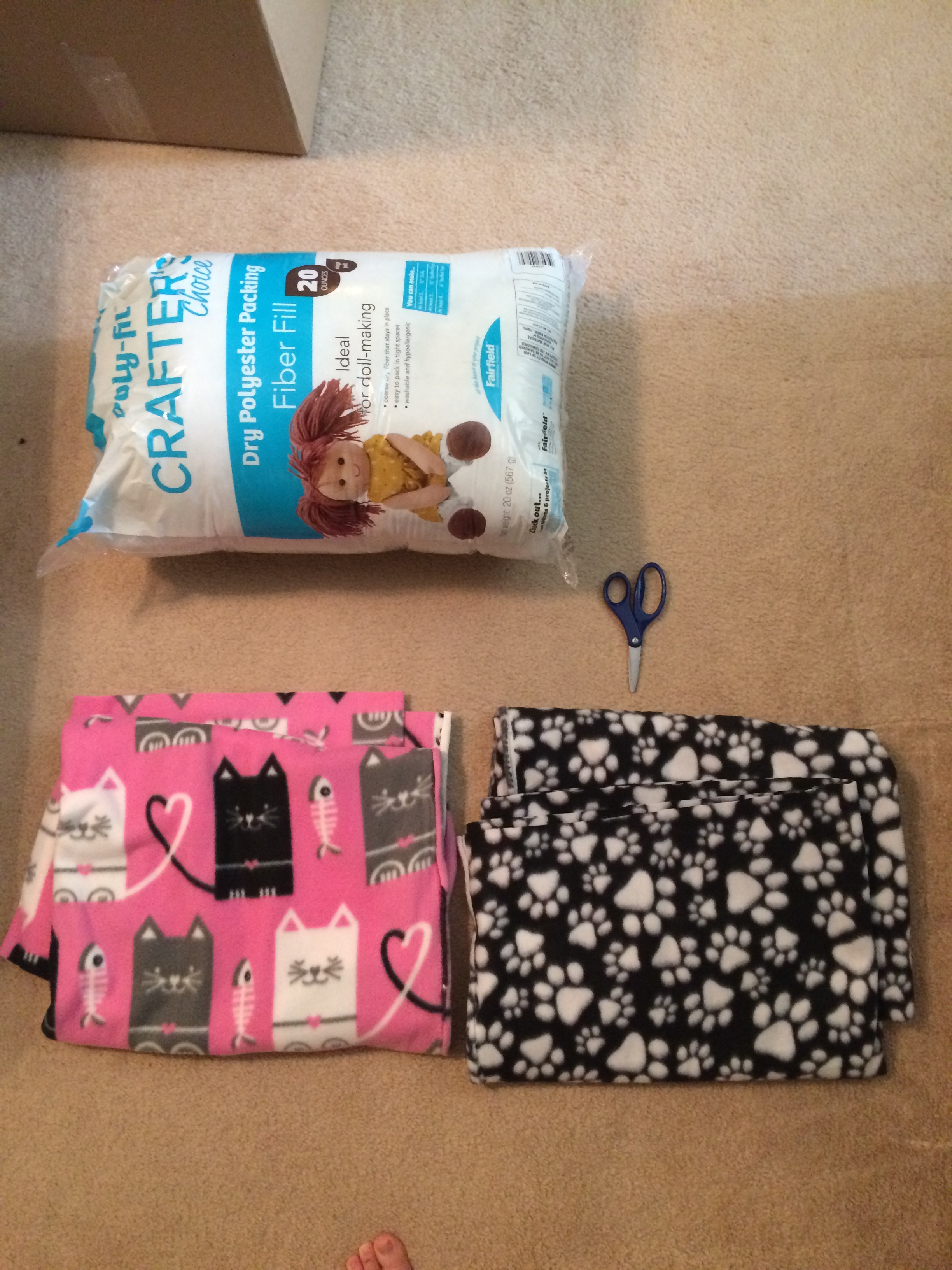
- One yard each of two different colors of fleece (cat-oriented print optional)
- Polyester fluff
- Scissors
- Ruler
Step 1: Lay the two different prints of fleece on top of each other and cut to your desired shape.
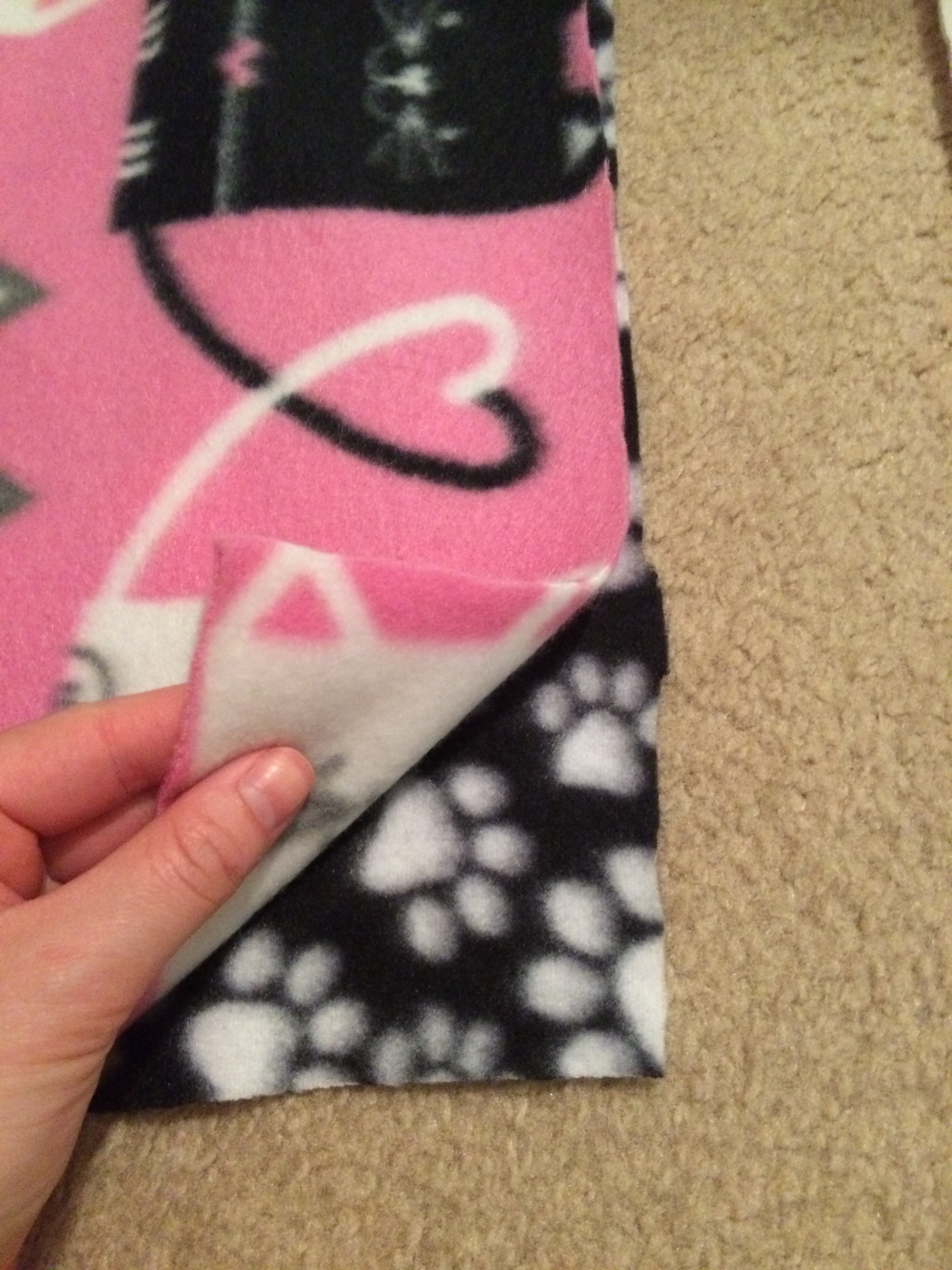
Step 2: Measure 4 inches into the fabric and cut squares out of each corner
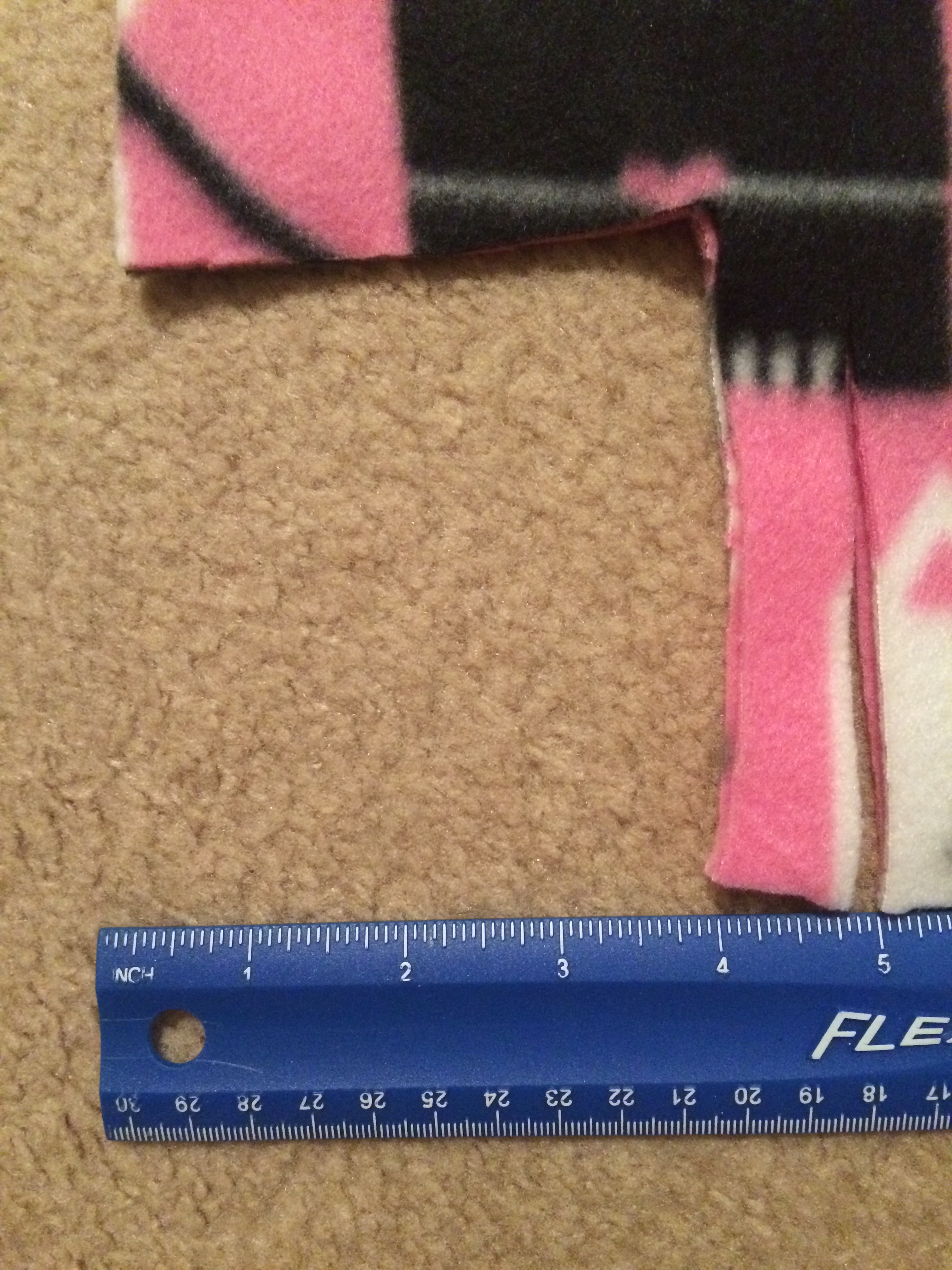
Your four pieces of fabric should look like this when done:
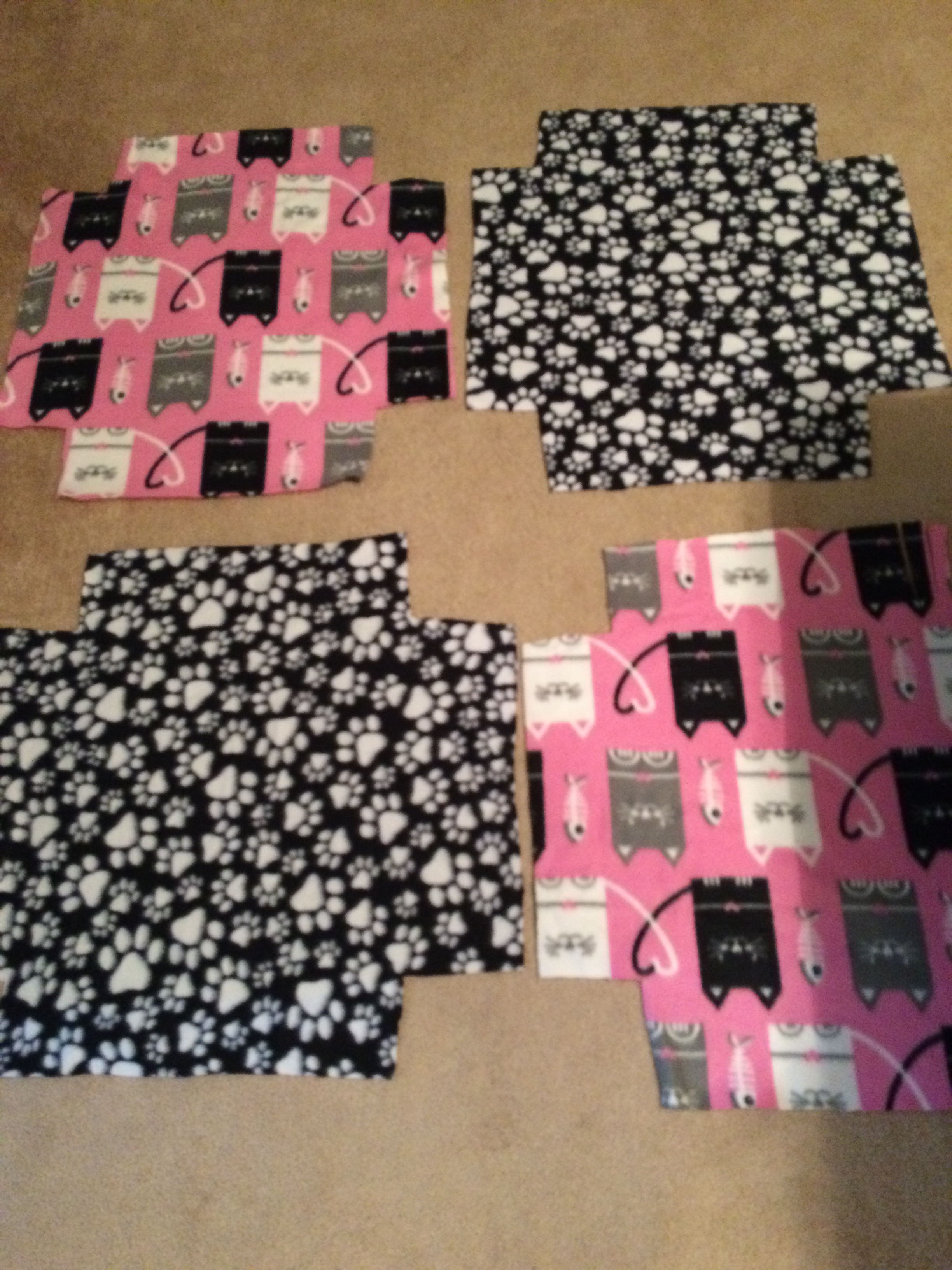
Step 3: Measure and cut strips that are about 1 inch wide and 4 inches long
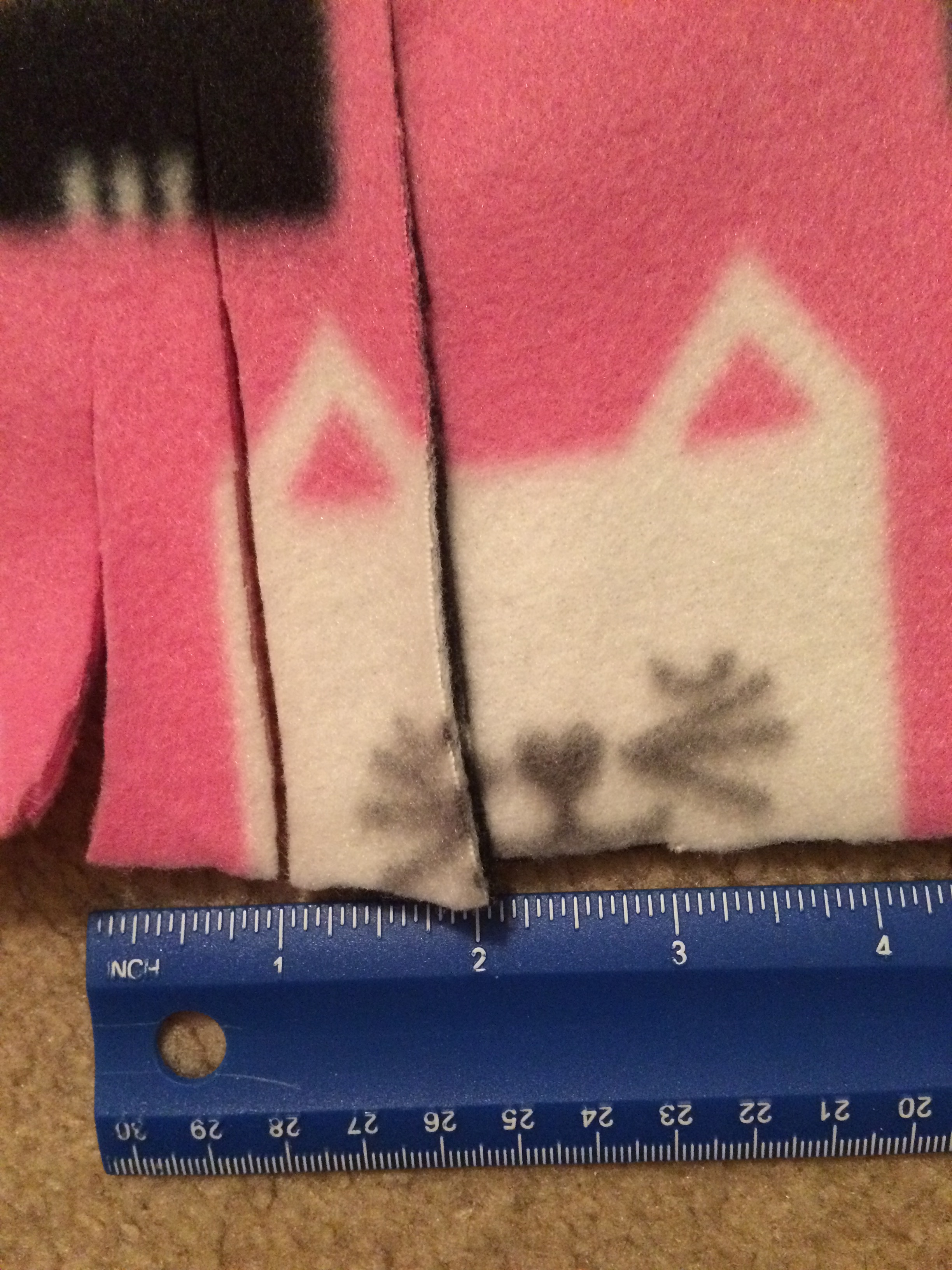
Your fabric should look like this when done:
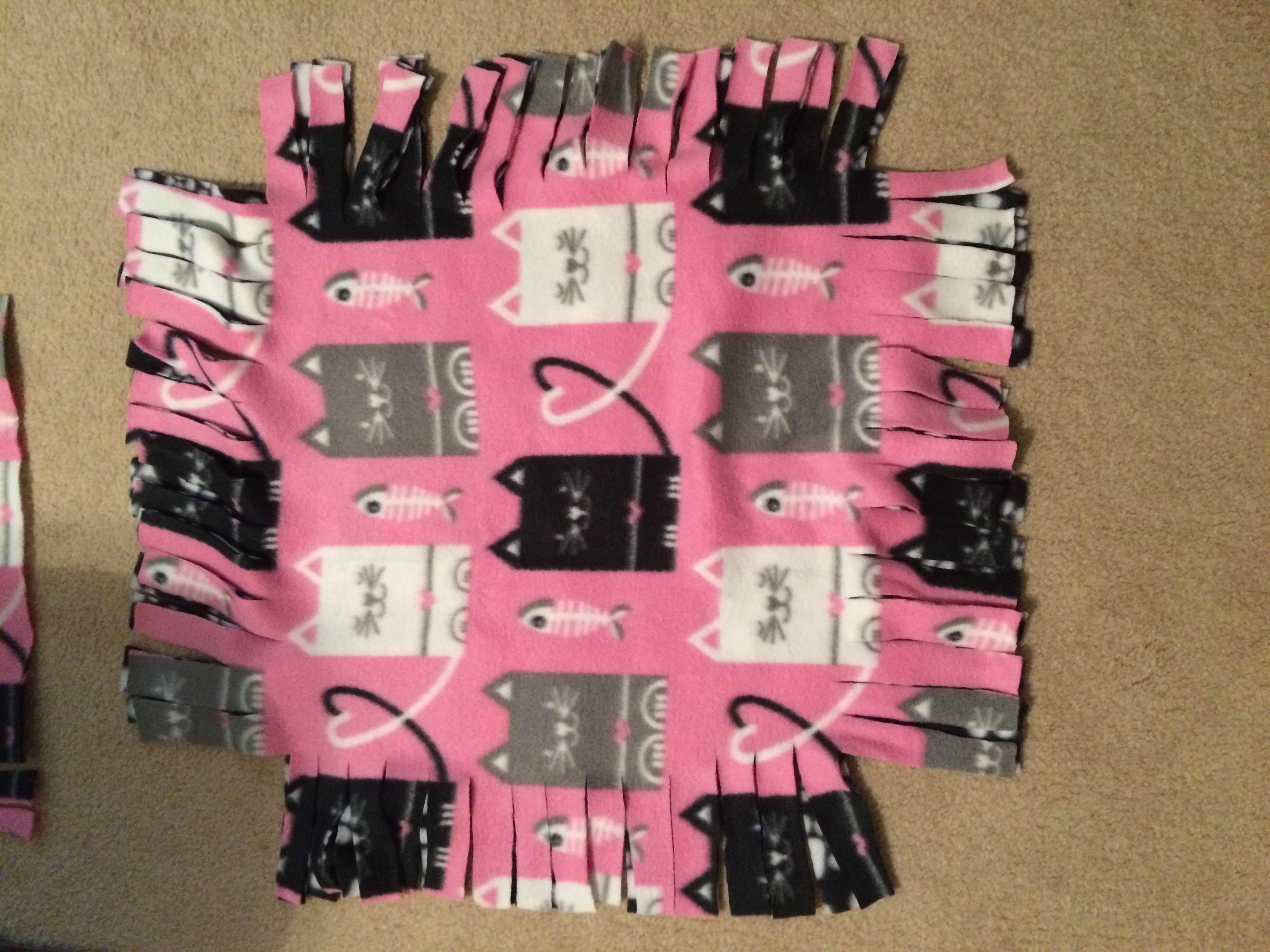
Step 4: Tie in a double knot (like your shoelaces) the two different strips of colored fabric all around the bed
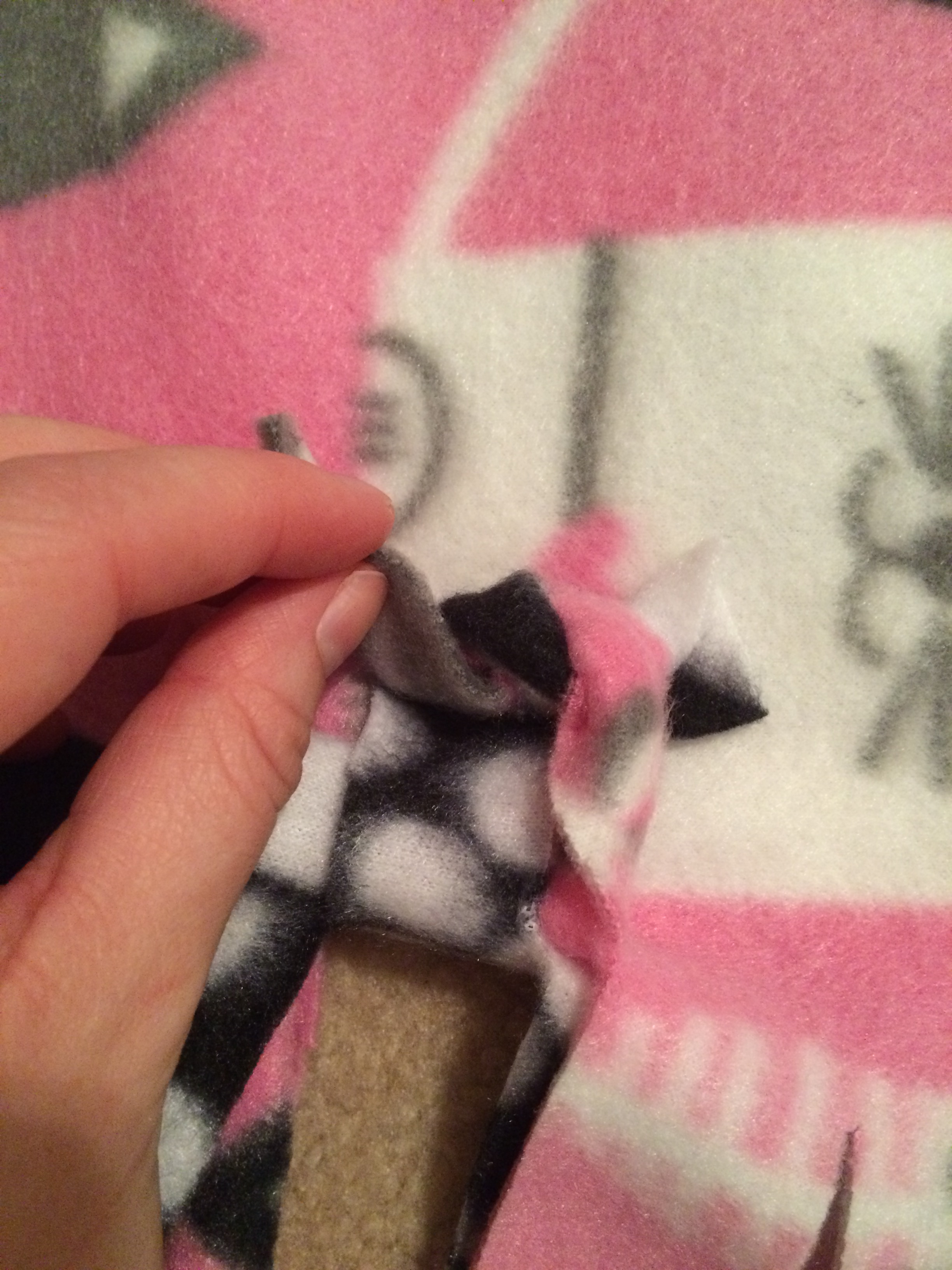
Step 5: When you’re done tying, leave about 4 inches open to stuff
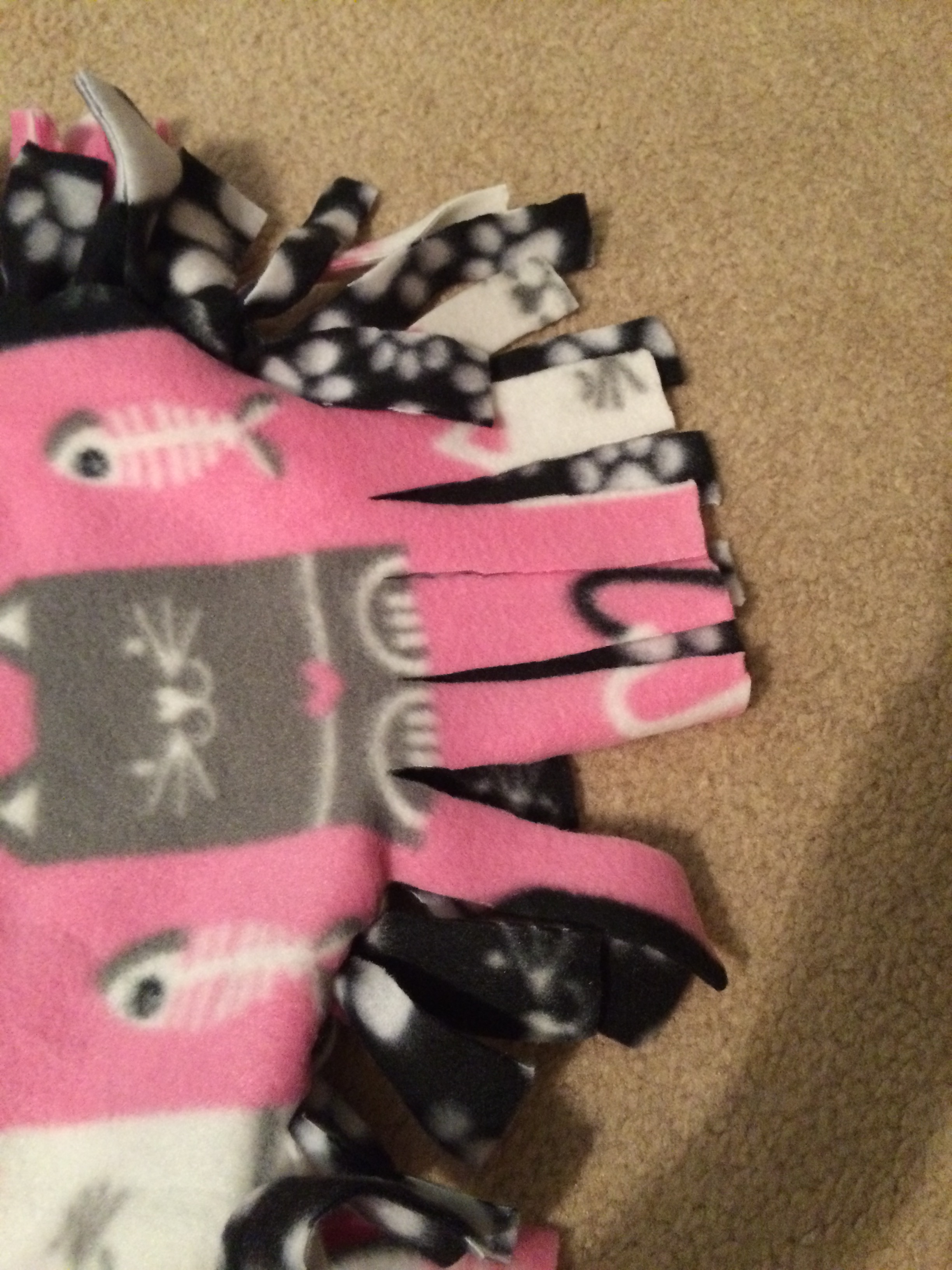
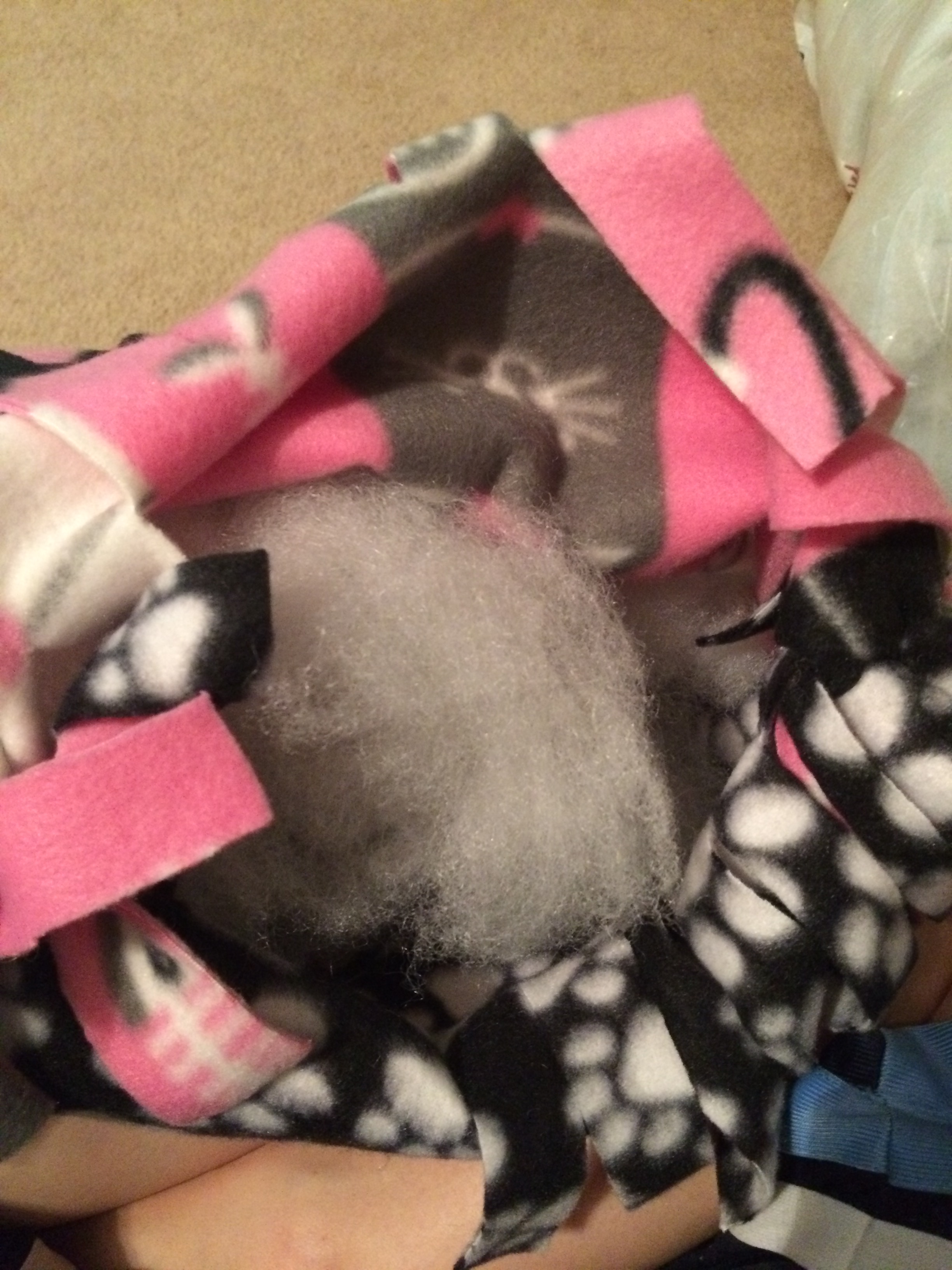
Step 6: Tie the bed closed, “fluff” it to distribute the stuffing, and you’re done!
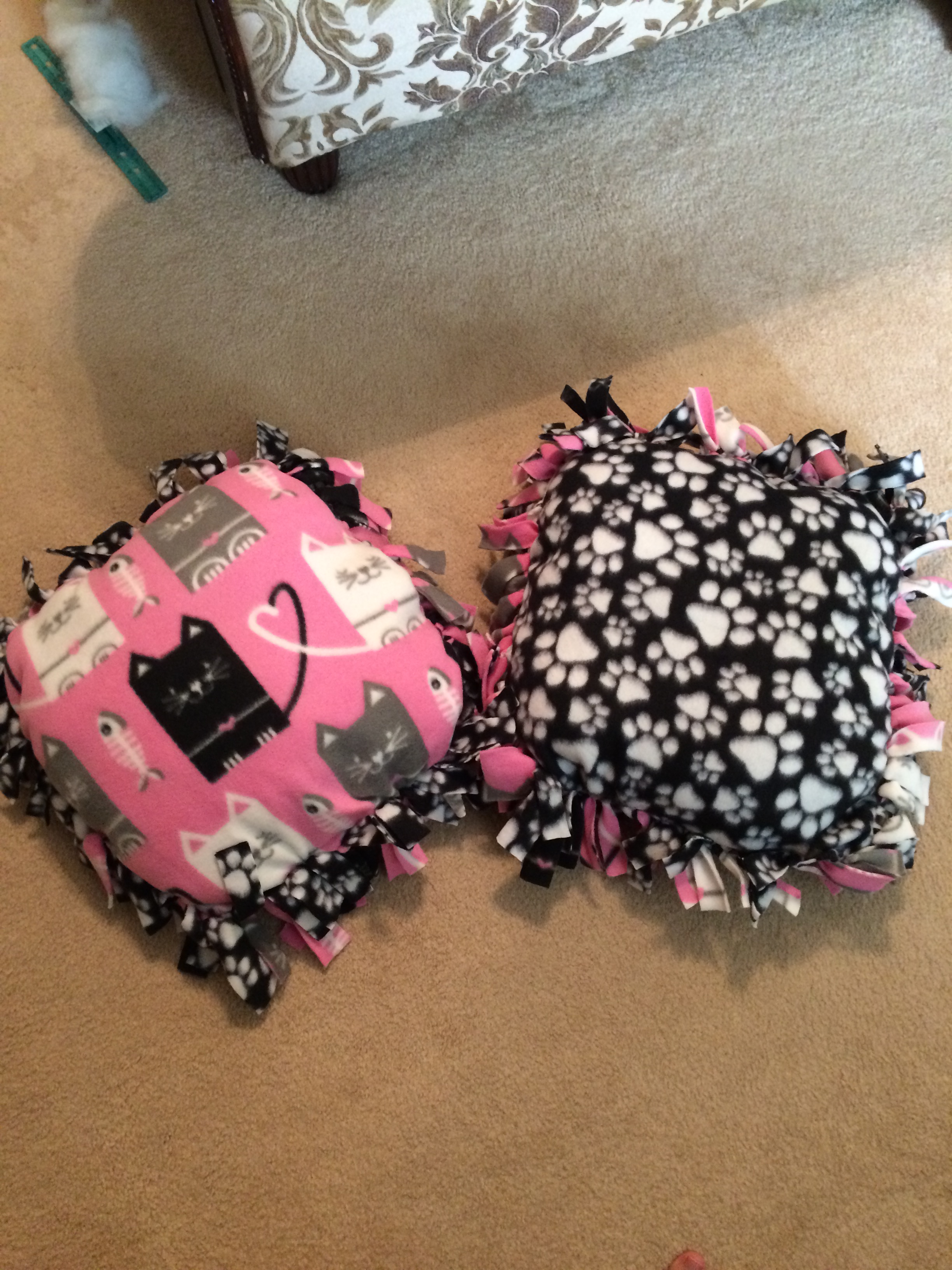
Baby Sock Feather Toy (makes 2 toys)
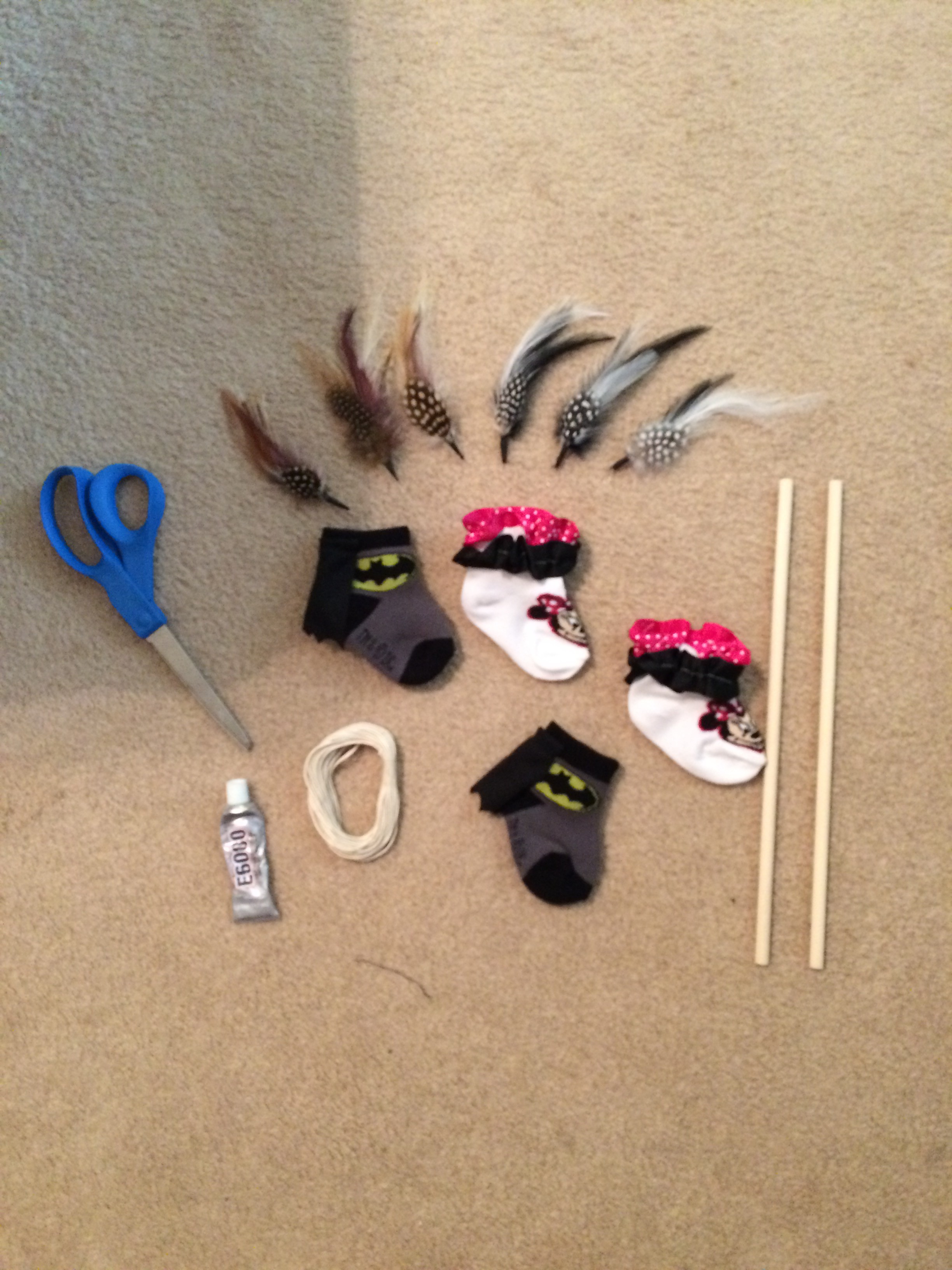
Supplies:
- Two wooden dowels
- String
- Glue
- Craft feathers
- Two pairs of infant socks
Step 1: Stuff one sock into another sock
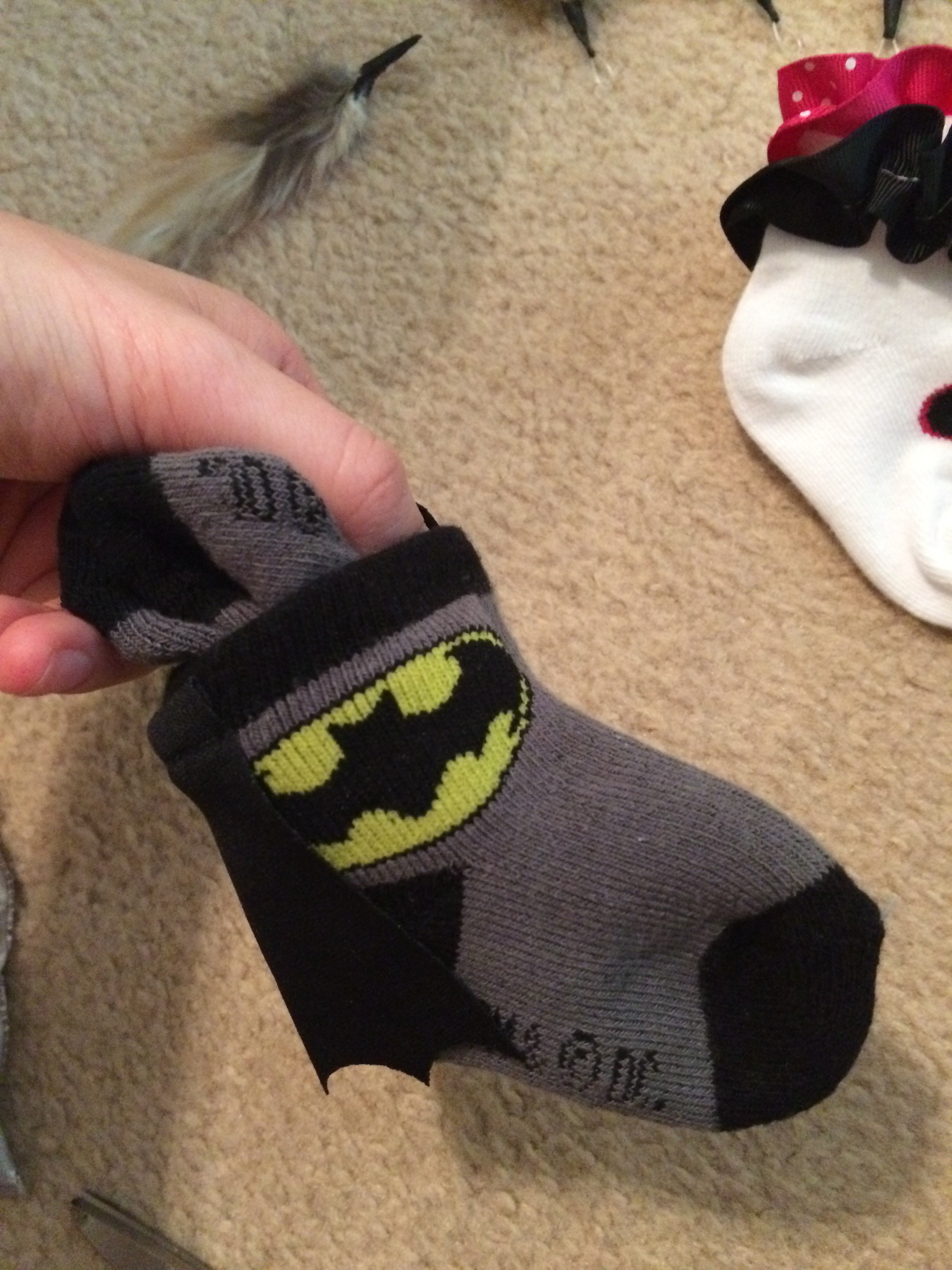
Step 2: Dab a little bit of glue at the opening of the sock and place the feathers in the glue
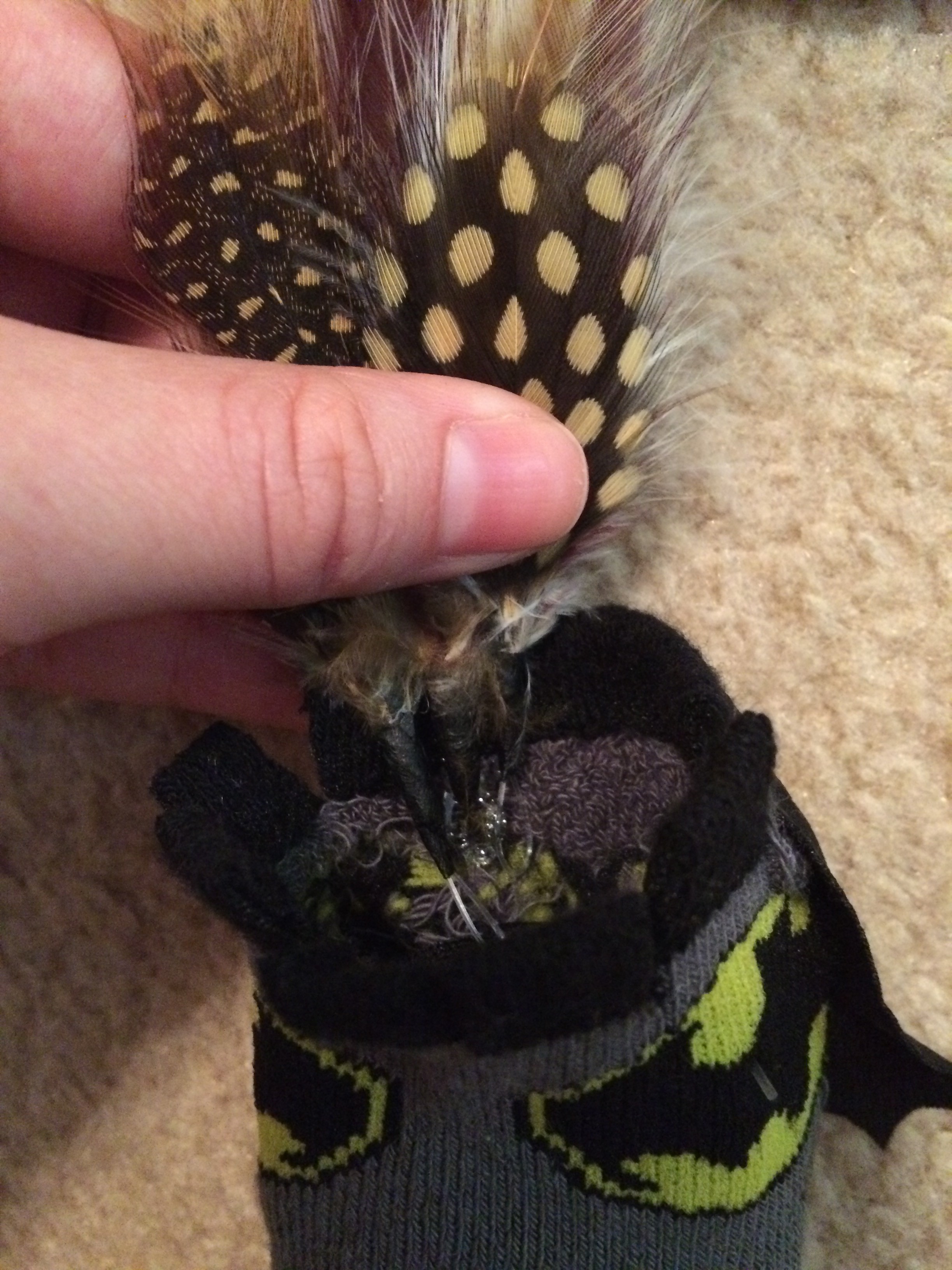
Step 3: Tie the sock closed. Measure about 1 1/2 foot of string
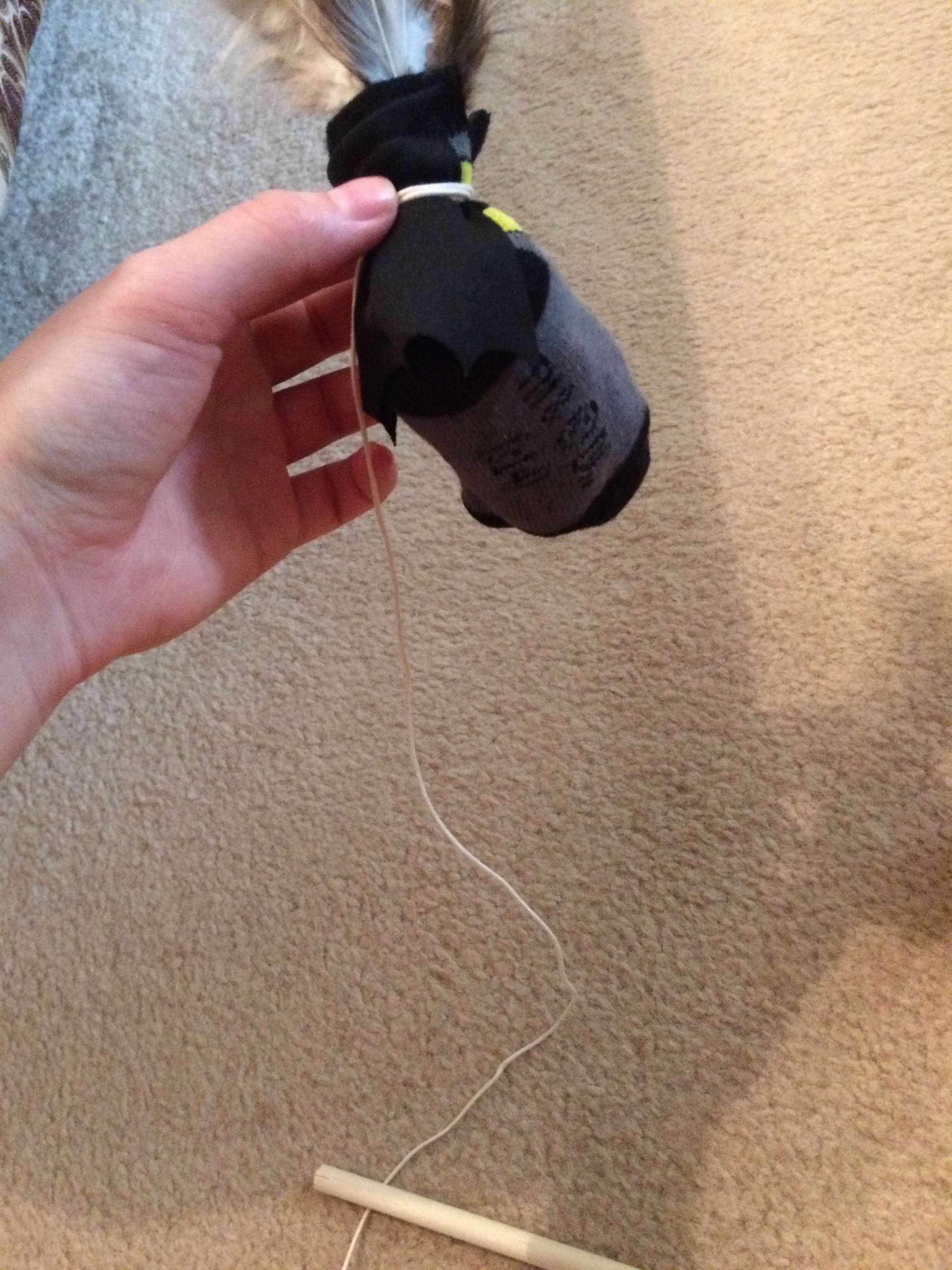
Step 4: Tie the string to the dowel. Dab some glue on the knot and wind the string around the knot and the glue.
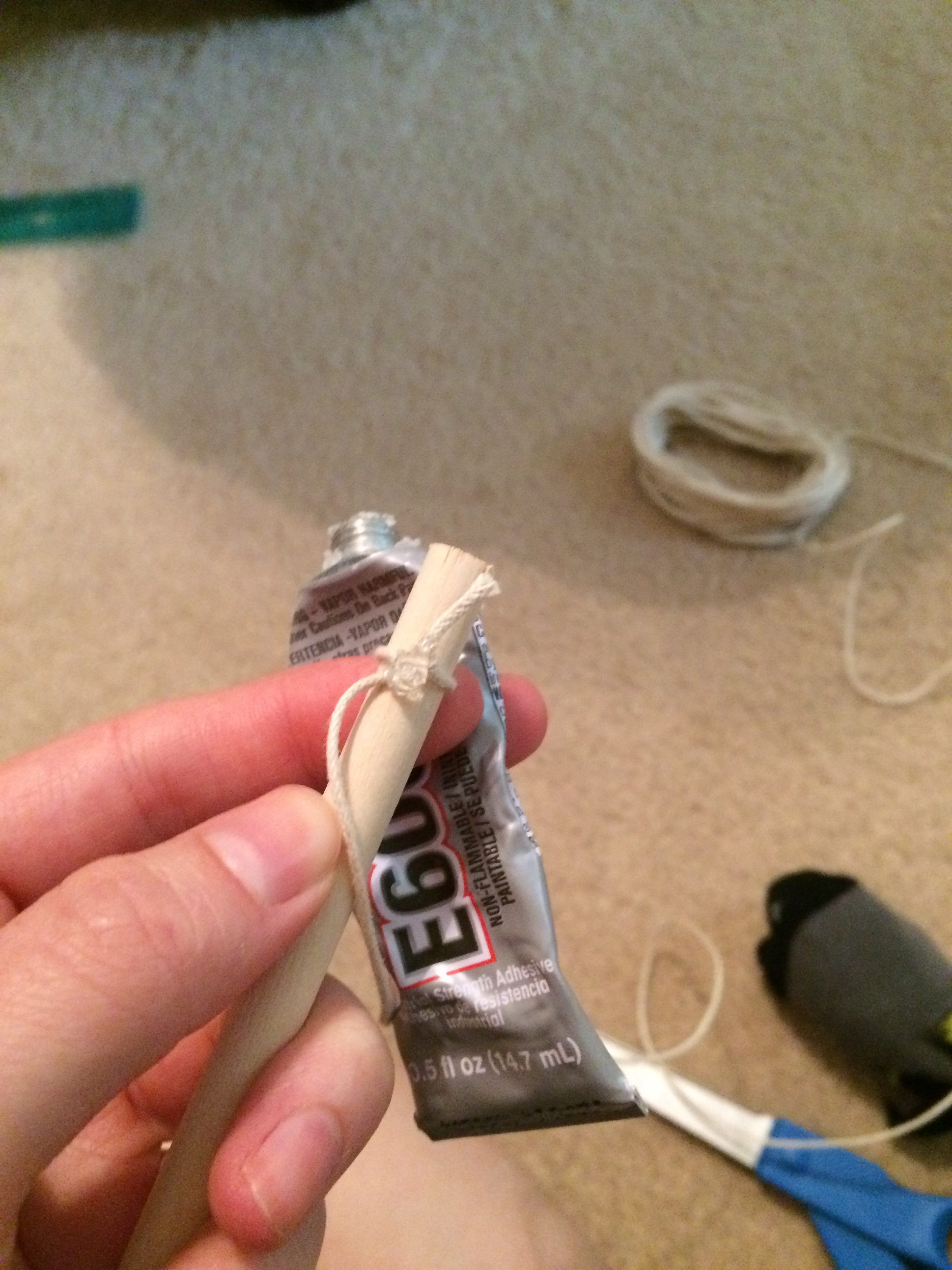
Step 5: Depending on how much glue you used, wait 8-12 hours for the glue to dry
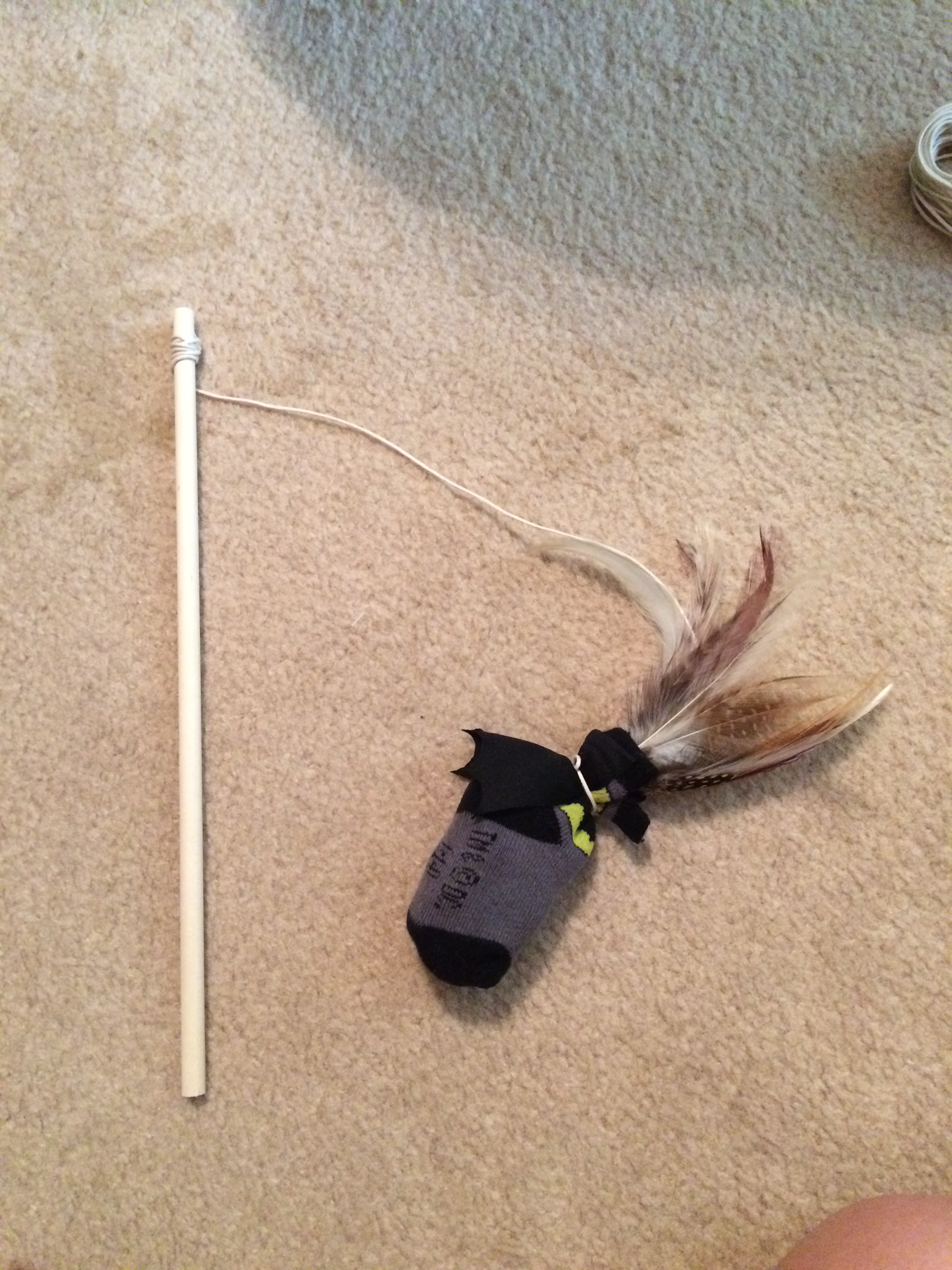

You’re done and now is time to do good! If you’re concerned that the cats will chew on the string and unravel the toy, place some ribbon around the string, or use a frilly baby sock like the Minnie Mouse sock above.
Now, most importantly, send or drop off these crafts to your local shelter! All the crafts you saw above were donated to Treehouse Humane Society. Happy crafting, and happy kitties!
It’s National Pet Fire Safety Day! While it is not the most exciting of holidays, it is definitely more than necessary. More than 1000 fires each year are started by cats and dogs, either accidentally, or because they really hate those tacky new curtains you put up. It’s important to know how to prevent fires and what to do with your pet in case of fire.
How to Prevent Fires
- Always make sure the oven is off and any candles are blown out before you go out.
- If you keep food on counters, keep it away from the stove. Your pet might get hungry and jump up to get one of the cookies you just baked, accidentally turning on the stove. Seems unlikely, but it has happened.
- Fix any faulty outlets and hide exposed wires. I know from experience that dogs love chewing on wires (as my puppy destroyed two of my laptop chargers and three phone chargers). It is important to watch them around these wires when you are home and put them in an inaccessible place when you are out.
 Practicing Fire Safety

- Do a fire drill. This way, you will be able to fix any flaws in your plan of escape.
- Keep all caged pets on the first floor and near exits so they can easily be rescued.
- Put up a fire rescue decal so first responders know how many pets you have.
- Install monitored smoke alarms so you can rest easy.
What To Do in Case of Fire
- Prepare an evacuation plan. Start by answering these questions:
- Which exit is closest in each room?
- Where will you meet your family members after the fire?
- Does everyone know the plan?
- Who will be in charge of what pets?
- Have your emergency kit somewhere easily accessible so you can quickly grab it on your way out.
I’m sure this article made you paranoid about fires, but if you practice fire safety (and remove those curtains Buster hates), you and your pets will be prepared to escape fires without harm.